Wonderful: Emerging Leader in Localized Enterprise AI Agents
Summary

Enterprise AI is entering its production phase. After years of chatbot pilots and AI demos, enterprises are now replacing legacy customer service, back-office, and business process outsourcing functions with autonomous AI agents capable of handling real business workflows. Wonderful AI B.V. (hereafter, "Wonderful"), an Amsterdam-headquartered company, is among a small group of companies competing to become the operating layer for this transition.
Wonderful is an enterprise AI agent platform built for deploying agents inside complex, real-world organizations. The company's specific bet is that the next wave of enterprise AI adoption will be won not on model quality alone, but on localization and deployment. Its strategy focuses on AI agents fluent in local language, culture, and regulation, supported by on-the-ground teams working closely with complex, non-English-speaking enterprises across a variety of industries including telecom, financial services, manufacturing, and healthcare.
This has let Wonderful expand to 30+ countries in barely a year, scale revenue and headcount aggressively, and raise three rounds (Seed, Series A, Series B), reaching a $2B valuation within eight months of emerging from stealth. The thesis is compelling and is showing up in the numbers. Over 70% of customers who start with a single use case (typically customer service) expand into additional workflows such as training, compliance, and sales enablement within three months. Agents deployed by Wonderful cut handling times by up to 60% and achieve containment rates above 80%, well ahead of the 40–65% industry norm for AI-driven support.
Although Wonderful's localization strategy introduces a more services-intensive delivery model than many software-first competitors, it prioritizes customer adoption and expansion over short-term software margins, a trade-off that appears justified by its early growth metrics. Its embedded deployment model accelerates customer adoption, while its horizontal platform architecture compounds value as customers expand into new workflows. As enterprises standardize on a single AI operating layer, switching costs increase and the economics become increasingly software-like. We believe Wonderful is well positioned to emerge as one of the category leaders in enterprise AI agents outside the English-speaking world.
Important Regulatory Disclosures
I, Santosh Rao, Head of Research, certify that: (1) All of the views expressed in this research report accurately reflect my personal views about the subject company, its private equity placement assets, and any associated financial instruments; (2) No part of my past, present, or future compensation was, is, or will be directly or indirectly related to the specific valuation estimates, financial projections, or views expressed by me in this research report.
Manhattan Venture Research is a wholly-owned subsidiary of Manhattan Venture Holdings LLC (“MVP”). MVP may currently and/or seek to do business with companies covered in its research report. As a result, investors should be aware that the firm may have a conflict of interest that could affect the objectivity of this report. Investors should consider this report as only a single factor in making their investment decision. This document does not contain all the information needed to make an investment decision, including but not limited to, the risks and costs.
Neither Manhattan Venture Research, VNTR Securities LLC, nor any of their affiliates or research analysts, beneficially own 1% or more of any class of common equity securities of Wonderful.
VNTR Securities LLC and its affiliates have not managed or co-managed a private placement or public offering of securities for Wonderful in the past 12 months, and have not received compensation for investment banking services from the subject company in the past 12 months.
VNTR Securities LLC does not engaged in any proprietary trading or act as a market maker in the subject company’s securities.
Additional information is available upon request. Information has been obtained from sources believed to be reliable but Manhattan Venture Research or its affiliates and/or subsidiaries do not warrant its completeness or accuracy. The user is responsible for verifying the accuracy of the data received.
This material is not intended as an offer or solicitation for the purchase or sale of any financial instrument. The opinions and recommendations herein do not take into account individual client circumstances, objectives, or needs and are not intended as recommendations of particular securities, financial instruments, or strategies to particular clients. The recipient of this report must make its own independent decisions regarding any securities or financial instruments mentioned herein. Periodic updates may be provided on companies/industries based on company-specific developments or announcements, market conditions, or any other publicly available information.
Valuation Methodologies and Risks: Valuations of private market technology assets are highly speculative. The internal valuation estimates presented in this report ($6.1B–$6.5B by 2031) are speculative and based on an implied average target EV/Revenue multiple of 31.7x derived from historical enterprise AI peers at IPO, applied to our 2031 projected revenue range of $478M–$511M. These future cash flows have been discounted to present value using a standard 20% venture discount rate. Material risks that could prevent Wonderful from achieving this projected valuation include: (1) highly intense competitive pressures from entrenched CRM incumbents and global software vendors, (2) severe technical degradation of language models when handling low-resource, non-English workflows, and (3) complex and prolonged enterprise sales and data-privacy compliance timelines. All pricing information for the securities discussed is derived from public information unless otherwise stated. Opinions and estimates constitute our judgment as of the date of this material and are subject to change without notice.
Manhattan Venture Research LLC does not assign traditional equity rankings (e.g., “Buy,” “Hold,” or “Sell”) to the securities covered in its research reports, nor does it employ a formal equity ratings system. Accordingly, no standardized distribution of ratings or corresponding investment banking relationships are provided. Over the past 12 months, VNTR Securities LLC or its affiliates have not managed or co-managed a public or private offering, nor received compensation for investment banking services from Wonderful.
Methodology
Our views on Wonderful are derived from our rigorous research process, involving proprietary channel checks with industry experts, and synthesizing publicly available information from the company and other reliable sources.
Key Points
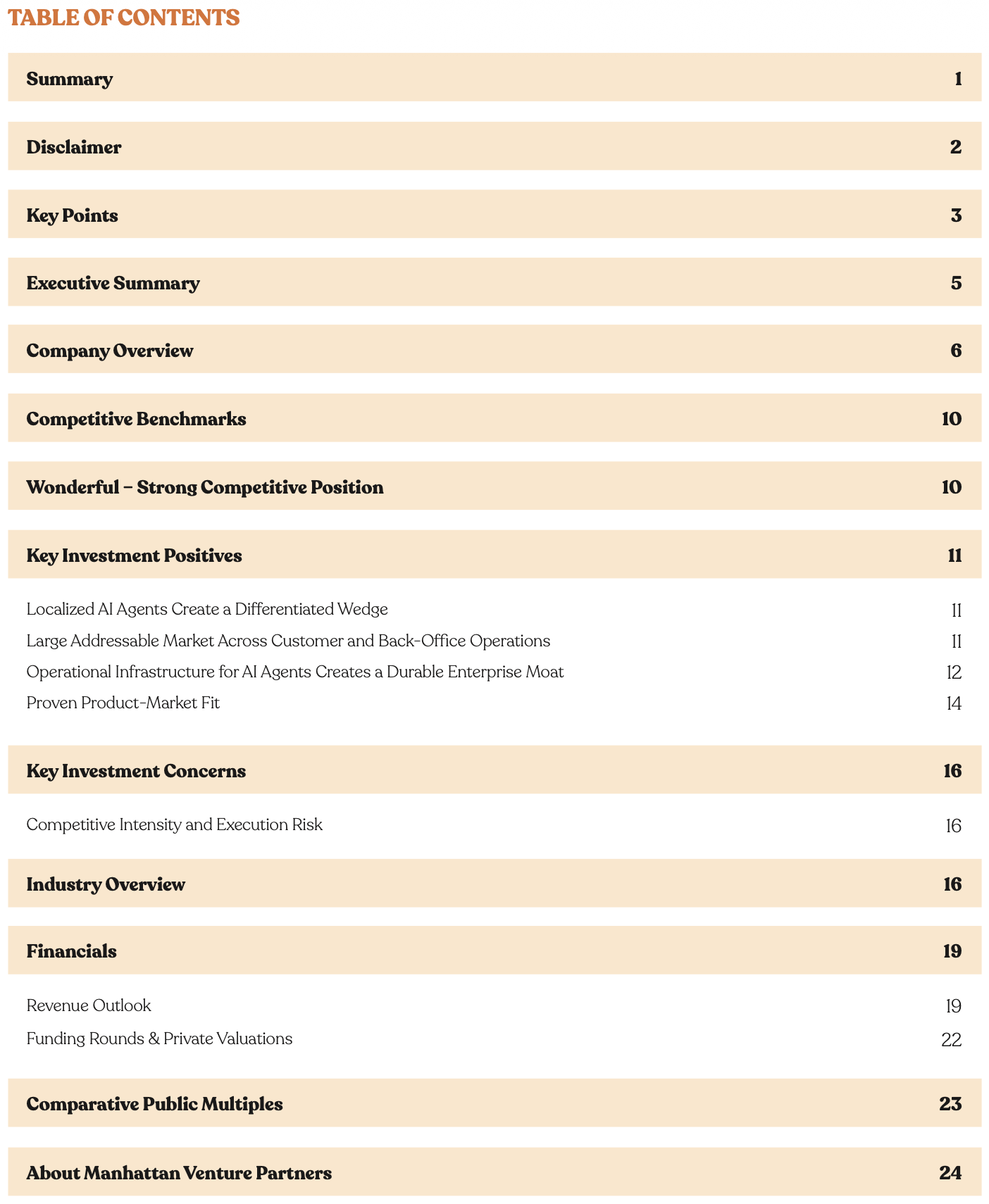
- Localized AI Agents Create a Differentiated Wedge: Wonderful is not merely selling AI chatbots; it is building a localized AI agent platform tailored to various aspects of enterprise customer service. The agents are designed to accommodate local languages, cultural nuances, regulatory requirements, and business workflows, all of which cannot be easily replicated through simple translation layers or generic foundation models. Customer service remains inherently local, with significant variations across markets in communication style, compliance obligations, escalation protocols, and operational processes.
- Large Addressable Market Across Customer and Back-Office Operations: While customer support serves as the initial entry point, Wonderful has the potential to expand across sales, HR, finance, procurement, legal, and IT workflows, among others. This is a classic land-and-expand opportunity: land with frontline service automation and expand progressively into higher-value internal enterprise operations.
- Operational Infrastructure for AI Agents Creates a Durable Enterprise Moat: Wonderful AI's core positive is that the company is not merely helping enterprises build AI agents; it is solving the harder and more valuable problem of getting agents to operate safely, reliably, and continuously inside complex enterprise environments.
- Proven Product-Market Fit: Wonderful has demonstrated strong product-market fit across multiple industries and geographies, with a proven ability to deliver measurable operational improvements at scale. Customers have realized substantial efficiency gains shortly after implementation. For example, Petrol Ofisi reduced IT call handling time by 75% within three weeks, while OTE Group tripled AI-driven call deflection and reduced average handling time by 30% in just eight weeks. Similar results were achieved by PPC Energie, which increased containment rates to 77% while eliminating wait times and maintaining 24/7 availability.
- Competitive Intensity and Execution Risk: Wonderful faces intense competition from global AI-agent platforms, contact-center automation vendors, CRM incumbents, and foundation-model companies. However, Wonderful's competitive edge is localization across geographies, deployment depth, and enterprise integration that is sticky. Rapid geographic expansion also creates operational complexity across languages, regulations, and support models, which the company is well-equipped to tackle.
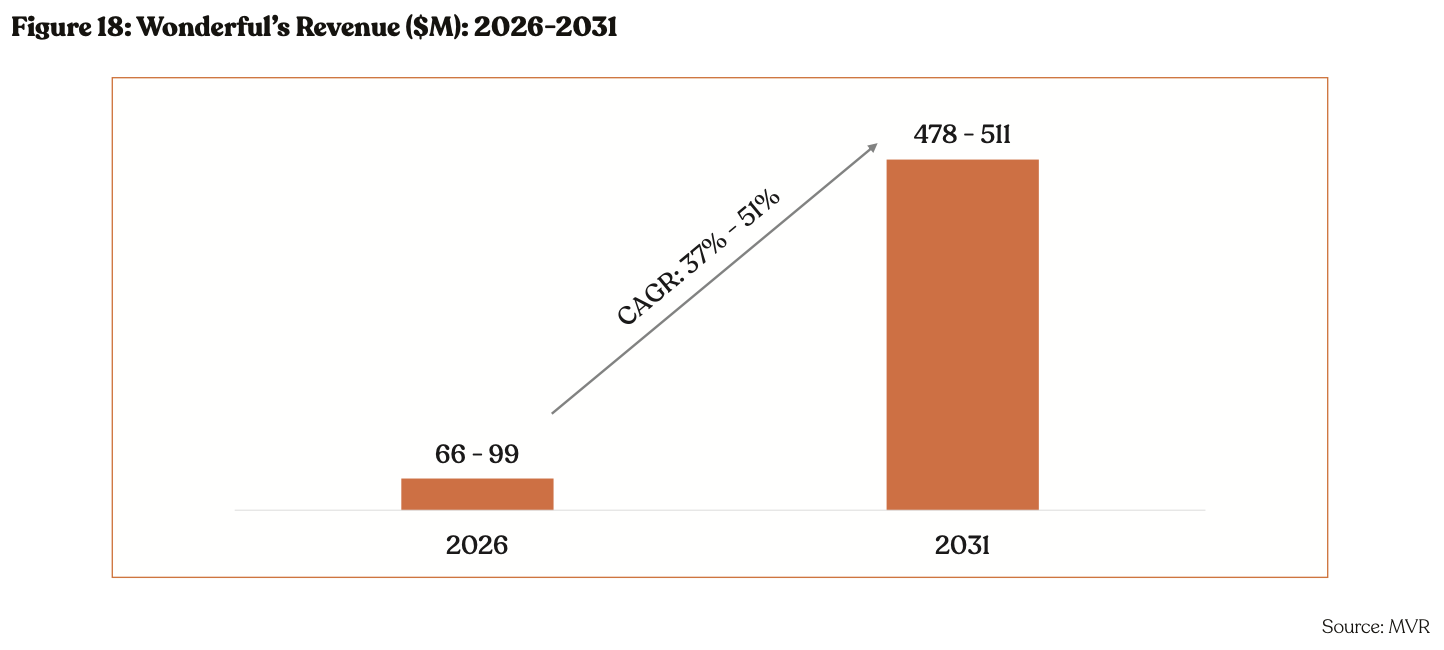
- Valuation: Wonderful's last reported private valuation was $2 billion as of May 2026. MVR internal projections peg Wonderful's 2026 revenue between $66 million and $99 million, with a trajectory toward $478 million – $511 million by 2031.
Executive Summary
Despite their impressive capabilities, AI agents have structural challenges. Performance often declines in languages beyond English, but language is only part of the challenge. Enterprise AI agents must also adapt to local cultural norms, communication styles, regulatory requirements, and business workflows. Interactions that feel natural in the US may not resonate in markets such as Germany or Norway. As AI agents become customer-facing interfaces, localized cultural and contextual intelligence will be essential for customer satisfaction, trust, and adoption.
This gap represents a significant market opportunity. While English remains the dominant language of AI development, there are only approximately 400 million native English speakers globally. Even including non-native speakers, the total English-speaking population is estimated at roughly 1 billion out of a global population of approximately 8.3 billion. As a result, most of the global workforce and consumer base primarily operate in other languages.
Enter Wonderful, an Amsterdam-headquartered enterprise AI agent company building localized AI agents for customer, employee, and back-office workflows. The company's core thesis is that enterprise AI agents cannot be one-size-fits-all. To automate repetitive work reliably at scale, agents must understand local languages, cultural nuances, regulatory requirements, business processes, and enterprise systems.
Wonderful focuses on non-English customer service markets, where mainstream AI platforms exhibit the largest performance gaps. Its AI agents operate across voice, chat, and email, supporting workflows such as billing disputes, account updates, appointment scheduling, technical support, and customer inquiry resolution.
By deploying AI agents locally and tailoring them to regional language, culture, and context, Wonderful addresses a fundamental limitation of today's globally trained AI models. This localization-first strategy provides a differentiated entry point into a rapidly expanding market. Rather than competing directly with horizontal AI agent platforms concentrated in English-speaking markets, Wonderful is establishing a defensible position across underserved geographies where localization is a prerequisite for adoption.
As enterprises increasingly demand AI solutions that operate effectively within local languages, regulatory frameworks, and cultural contexts, Wonderful is well positioned to build a highly differentiated, sticky, and defensible platform within the enterprise AI agent ecosystem.
Why Now?
The performance of large language models (LLMs) degrade in languages other than English. The strongest evidence comes from MMLU-ProX, a March 2025 study that evaluated 36 leading LLMs across 29 languages using nearly 12,000 questions per language. The findings reveal a clear performance hierarchy. High-resource European languages such as Spanish, French, and German exhibit accuracy declines of approximately 5–8% relative to English. Major Asian and Middle Eastern languages including Arabic, Hindi, and Turkish experience 10–15% degradation. The gap widens substantially for lower-resource languages, particularly across Africa and parts of Asia, where performance can be 25–40% worse. In extreme cases, models achieving 80% accuracy in English fall to approximately 40% accuracy in languages such as Swahili and Wolof.
Language proficiency, however, is only one dimension of the challenge. Effective AI agents must also understand local cultural norms, communication styles, and contextual nuances. Behaviors perceived as polite and appropriate in the US may be viewed differently in markets such as Germany or India. As AI agents become customer-facing, these cultural and contextual adaptations become increasingly critical to user satisfaction, trust, and engagement.
By deploying AI agents locally and tailoring them to regional language, culture, and context, Wonderful is addressing a fundamental limitation of today's globally trained AI agents. This localized approach positions the company to build a highly differentiated, defensible, and sticky market position within the rapidly expanding AI agent ecosystem, particularly across large underserved non-English markets where incumbents exhibit meaningful performance gaps.
For most AI startups, the bull case is that their agents are better. For Wonderful, the bull case is not only better agents, but also operating AI agents safely and reliably inside enterprises which is extremely hard.
Company Overview
AI has the potential to reshape how enterprises operate but realizing that potential requires more than access to models and tools. Successful adoption depends on embedding AI into the operating model of the organization and integrating it into the workflows that drive day-to-day performance.
Wonderful works with enterprises to accelerate AI adoption across customer, employee, and back-office functions. The company combines a multi-model AI platform, local deployment teams, and advisory expertise to help organizations identify, implement, and scale AI-enabled workflows.
Founded to address the gap between AI capability and enterprise adoption, Wonderful focuses on helping organizations move from experimentation to operational impact. Its approach emphasizes practical deployment, organizational readiness, and the integration of AI into existing business processes.
The company operates with a focus on speed, accountability, and execution. Teams are encouraged to act independently, solve problems proactively, and take ownership of outcomes. This emphasis on professionalism, clarity, and reliability reflects the requirements of enterprise environments, where technology decisions must balance innovation with operational resilience.
Competitive Benchmarks
Wonderful's seamless multilingual capabilities drive stronger customer engagement across diverse demographics, making it well-suited for diverse agentic AI interactions. Its robust focus on security and confidentiality fosters user trust, a critical factor for sensitive AI agent uses. Additionally, instant, no-wait customer support enhances user satisfaction and strengthens loyalty in highly competitive markets.
With 152 customer review respondents and an average rating of 4.8/5 (per Featured Customers), Wonderful has far deeper and more positive user feedback than peers at a similar stage in their journey. For comparison, Vapi, Netomi, Rasa, and Sierra each have between 11 and 16 reviewers, with scores ranging from 2.4/5 to 4.8/5 (per data from G2 and Trustpilot).
Additionally, Wonderful is building orchestration and infrastructure for AI agents that can operate across voice, chat, and email, rather than a single-channel bot or workflow tool. This makes it easier for large enterprises to roll out AI agents "everywhere" rather than adopt multiple point vendors.
Furthermore, Wonderful has focused on non-English-speaking markets and locales that most US-centric competitors underserve, giving it differentiated data, language coverage, and go-to-market advantages.


Wonderful – Strong Competitive Position
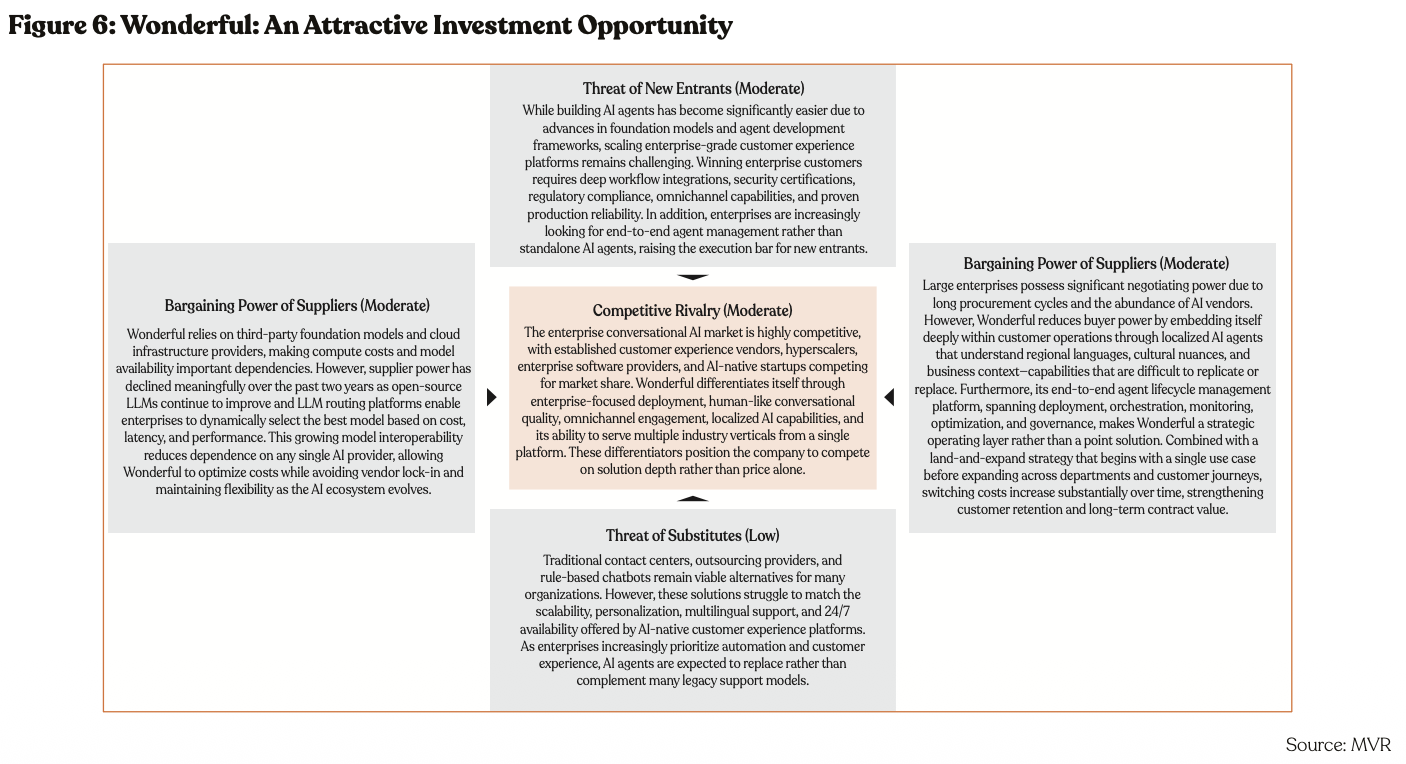
A Porter's Five Forces analysis of Wonderful suggests a favorable competitive position within the rapidly growing enterprise AI agent market. Wonderful benefits from increasing enterprise adoption of AI agents, growing switching costs as deployments expand, and a technology ecosystem that is becoming less dependent on any single supplier. The following analysis evaluates the industry's attractiveness and Wonderful's competitive positioning across the five forces.
Threat of New Entrants (Moderate): Although advances in foundation models and agent development frameworks have made it easier to build AI agents, developing a scalable enterprise-grade customer experience platform remains considerably more difficult. Enterprise customers require deep integration with existing systems, strong security and compliance standards, omnichannel capabilities, and proven reliability in production environments. Furthermore, customer demand is increasingly shifting toward comprehensive agent management platforms that oversee deployment, orchestration, monitoring, optimization, and governance rather than standalone AI agents.
Bargaining Power of Customers (Moderate): Large enterprises often possess significant negotiating leverage due to lengthy procurement processes and the growing number of AI vendors competing for contracts. However, Wonderful reduces buyer power by embedding itself deeply within customer operations through localized AI agents that understand regional languages, cultural nuances, and business-specific context. As customers expand deployments across departments through its land-and-expand strategy, switching costs increase substantially.
Threat of Substitutes (Low): Traditional contact centers, outsourcing providers, and rule-based chatbot solutions continue to serve as alternative approaches. However, these solutions struggle to match the scalability, personalization, multilingual capabilities, and continuous availability offered by AI-native platforms. As enterprises prioritize automation, AI agents are replacing rather than complementing legacy support models.
Bargaining Power of Suppliers (Moderate): Wonderful relies on third-party foundation model providers and cloud infrastructure vendors. However, supplier influence has weakened as open-source LLMs improve and LLM routing platforms allow companies to dynamically select models based on cost, latency, and performance requirements, avoiding vendor lock-in.
Competitive Rivalry (Moderate): The market includes established CX vendors, hyperscalers, SaaS incumbents, and AI-native startups. Wonderful differentiates itself through enterprise-grade deployment, human-like conversational quality, omnichannel engagement, localized AI capabilities, and multi-vertical delivery from a unified platform.
Key Investment Positives
Localized AI Agents Create a Differentiated Wedge
Wonderful is not simply selling AI chatbots; it is building a localized AI agent platform designed around the realities of enterprise customer service. Its agents are adapted to local languages, cultural nuances, regulatory requirements, and business workflows. These are capabilities that are difficult to replicate through simple translation or generic foundation models. Customer service remains highly local: tone, compliance obligations, escalation protocols, and operating processes vary materially across markets. A Hebrew-, Arabic-, Greek-, Dutch-, or Italian-speaking agent requires far more than language translation to perform effectively in production environments.
This localization capability creates a meaningful competitive advantage at a time when many AI deployments remain fragmented and experimental. As enterprises adopt AI, two common patterns emerge. Some distribute pilots across multiple vendors and departments, while others attempt to build internally. Both approaches often produce a growing collection of disconnected experiments that generate isolated successes but fail to create enterprise-wide capabilities or long-term strategic value.
The in-house path is particularly deceptive. While advances in AI have made it easy to build a functional prototype, the challenge lies in deploying agents reliably within complex enterprise environments. Enterprise-grade deployments require deep integrations with legacy systems, robust handling of edge cases, continuous evaluation and optimization, and operational expertise accumulated across hundreds of real-world implementations. These capabilities are difficult, time-consuming, and expensive for enterprises to develop internally, particularly when AI infrastructure is not core to their business.
A multi-vendor strategy frequently leads to a similar outcome. Individual teams may demonstrate progress through separate pilots, but the resulting agents often operate on different infrastructures, evaluation frameworks, quality standards, and deployment processes. Over time, this creates fragmented architectures that are costly to maintain and even more costly to consolidate.
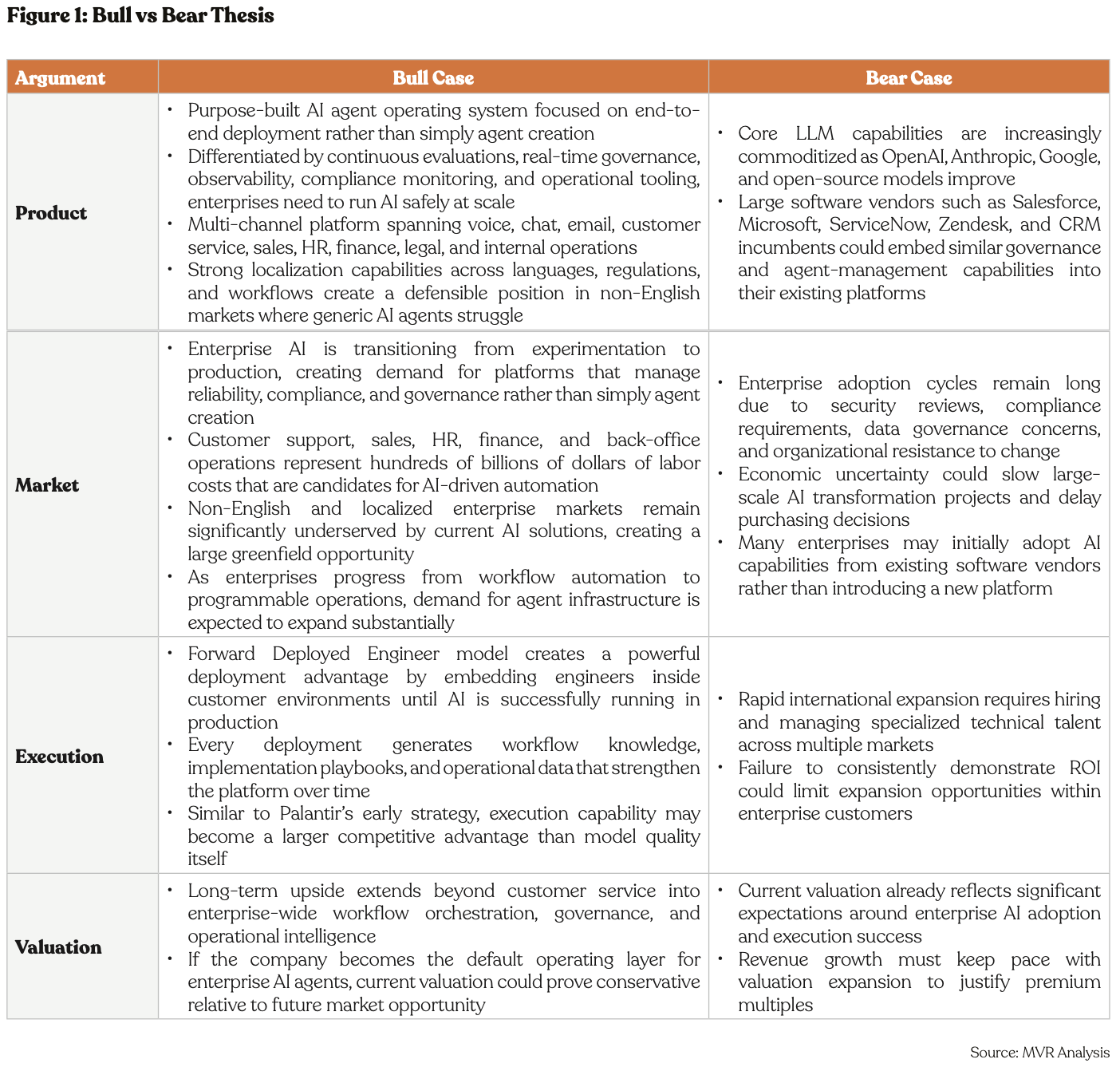
Wonderful is positioned around a fundamentally different model. Rather than delivering standalone AI projects, it provides a shared operating system for enterprise AI agents. Customers can redesign a specific business function end-to-end, establish the necessary integrations and feedback loops, and then extend that foundation to additional use cases over time. Each deployment strengthens the value of the platform by expanding the underlying infrastructure, integrations, operational knowledge, and data assets available for future implementations.
This creates a compounding dynamic that is strategically attractive. While customers may initially launch with a limited number of use cases, each deployment increases switching costs, accelerates future rollouts, and improves platform performance across the organization. As adoption expands, Wonderful benefits from growing implementation expertise across industries, geographies, languages, and regulatory environments—building a defensible moat that becomes increasingly difficult for point solutions, internal teams, or generic AI vendors to replicate.
Local Deployment Teams Strengthen Enterprise Adoption: Wonderful combines a multi-model AI platform with embedded local implementation teams. This reduces one of the biggest barriers in enterprise AI: moving from demo to production. By sending local teams to integrate agents into enterprise systems and tune them for country-specific workflows, Wonderful can shorten deployment cycles and increase customer trust.
Large Addressable Market Across Customer and Back-Office Operations
The initial wedge is customer support, but the platform can expand into sales, HR, finance, procurement, legal, IT, and healthcare workflows. This gives Wonderful a land-and-expand path: start with frontline service automation, then move deeper into internal enterprise operations.
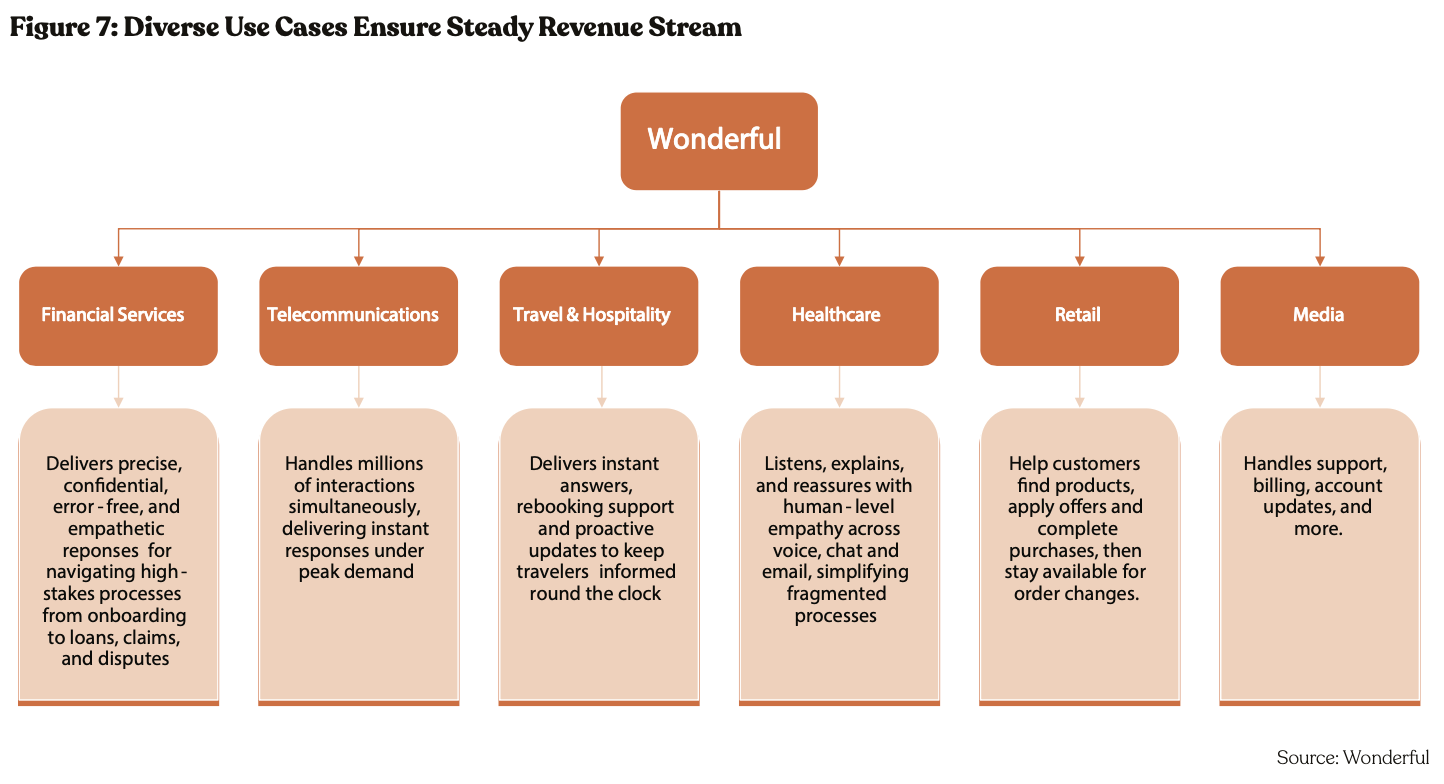
Another strong advantage of Wonderful is the breadth of customer interactions its platform can support across industries. As illustrated below, the same underlying AI architecture can handle highly regulated financial services workflows, managing millions of telecom customer interactions, providing real-time travel assistance, delivering empathetic healthcare support, guiding retail purchases, and resolving media account and billing issues. This demonstrates that Wonderful is not a point solution built for a single use case, but a flexible enterprise platform that can adapt to a wide range of customer-facing workflows.
The common thread across these industries is the need for accurate, scalable, always-available, and human-like customer engagement. By proving its ability to deliver these capabilities across multiple verticals, Wonderful reduces customer concentration risk while creating numerous expansion opportunities. Every new industry deployment strengthens the platform’s training data, workflow intelligence, and enterprise credibility, making it increasingly difficult for single-vertical competitors to replicate its breadth of capabilities. This positions Wonderful to capture a larger share of the rapidly growing enterprise customer experience market while benefiting from repeatable deployments across multiple sectors.
Operational Infrastructure for AI Agents Creates a Durable Enterprise Moat
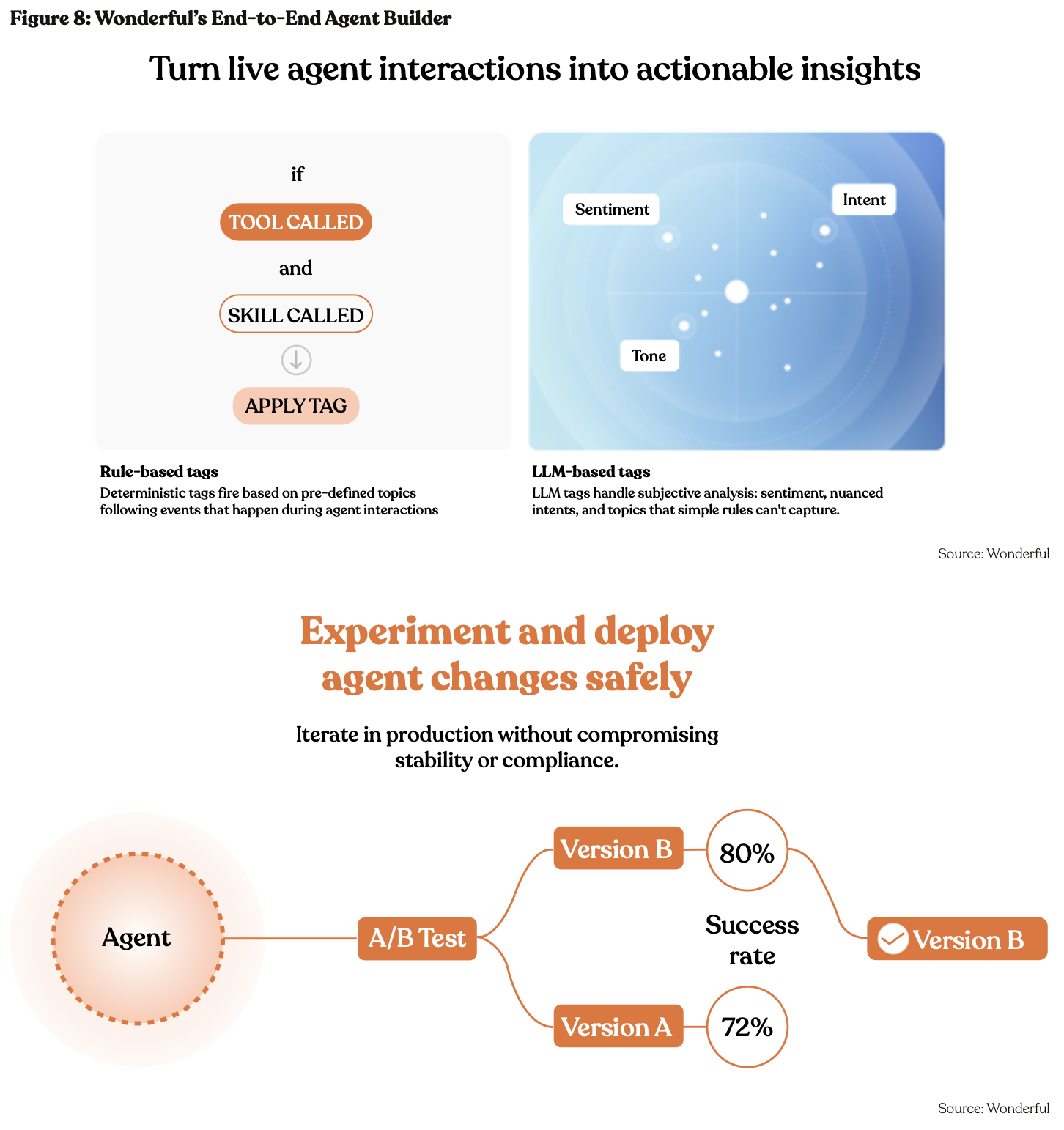
Wonderful AI’s core investment positive is that the company is not merely helping enterprises build AI agents; it is solving the harder and more valuable problem of getting agents to operate safely, reliably, and continuously inside complex enterprise environments. Over the past year, agent creation has become significantly easier as LLM APIs, orchestration frameworks, and developer tools have lowered the barrier to building functional prototypes. However, this ease of creation also risks commoditizing the “agent builder” layer. The real enterprise bottleneck has shifted from building agents to deploying, governing, monitoring, and improving them in production. Wonderful is well positioned because its platform is designed around this operational reality.
In enterprise settings, agents do not operate in clean demo environments. They interact with customers, internal systems, sensitive data, legacy software, compliance rules, and business-critical workflows. This makes reliability, governance, and observability just as important as model intelligence. Wonderful addresses this through a production-grade operating layer that includes continuous evaluations, real-time policy guardrails, monitoring, alerts, analytics, and interaction-level traceability. This allows enterprises to test agent behavior before deployment, detect regressions as prompts, models, tools, and knowledge bases evolve, and enforce compliance policies during live customer interactions. In other words, Wonderful turns AI agents from experimental workflows into controllable enterprise infrastructure.
This distinction is important because most organizations are still stuck between successful pilots and scaled adoption. A prototype can feel impressive, but production deployments require answers to harder questions: whether the agent behaves correctly across thousands of edge cases, whether sensitive data is protected, whether failures are detected in real time, and whether teams can trace problems back to the exact moment they occurred. Wonderful’s continuous evaluation and governance layer gives enterprises the confidence to expand agent usage without losing control. This creates a strong adoption advantage in regulated or operationally complex industries such as banking, telecom, insurance, healthcare, travel, and enterprise services.
Wonderful also benefits from a powerful execution model through its Forward Deployed Engineers. Similar to Palantir’s approach, these engineers are embedded directly inside customer environments and own the technical outcome end-to-end. They integrate with legacy systems, navigate security constraints, align stakeholders, debug production failures, and convert messy customer-specific problems into repeatable platform capabilities. This is a major competitive advantage because enterprise AI deployment is rarely a pure software sale. It is a last-mile implementation challenge. By combining a scalable AI-agent platform with high-touch technical deployment, Wonderful increases the likelihood that customers move from pilot to production and from single-use-case adoption to broader workflow transformation.
The company’s long-term opportunity becomes even more compelling when viewed through the three stages of enterprise AI adoption. At Level 1, agents substitute for human tasks by answering support questions, qualifying leads, drafting responses, or pulling data across systems. At Level 2, enterprises begin rewriting workflows around agent capabilities, reducing handoffs, collapsing queues, and enabling more personalized, context-rich operations. At Level 3, operations become programmable: every retrieval, decision, escalation, and policy deviation can be logged, tested, measured, and improved. Wonderful is building infrastructure for this third stage, where the largest strategic value lies. The platform does not simply automate work; it makes operations more measurable, tunable, and continuously improvable.
This creates a compounding moat. As Wonderful deploys more agents across markets, languages, industries, and enterprise workflows, it accumulates implementation knowledge, production failure data, workflow patterns, governance templates, and localization depth. These learnings can improve future deployments and make the platform harder to replace. Competitors may be able to build agents, but replicating Wonderful’s combination of operational tooling, real-world deployment expertise, local market understanding, and enterprise trust will be more difficult. Therefore, Wonderful’s defensibility is not only in its AI models, but in its ability to make AI agents safe, observable, compliant, and useful in real production environments.
Comprehensive Agentic Solutions Ensure Widespread Adoption: A key investment strength of Wonderful lies in its model-agnostic agentic infrastructure, which enables broad enterprise adoption. The platform securely benchmarks, routes, and optimizes across leading AI models in real time, ensuring best-in-class performance for every use case while maintaining flexibility as the AI landscape evolves.
The infrastructure is deeply integrated into core enterprise systems, allowing agents to operate within the organization’s existing workflows. This ensures agents are grounded in real business processes, can access and act on live enterprise data, and continuously update systems of record. The platform is built for enterprise-scale deployment, supporting tens of thousands of concurrent sessions and high-volume workloads without compromising performance or reliability.
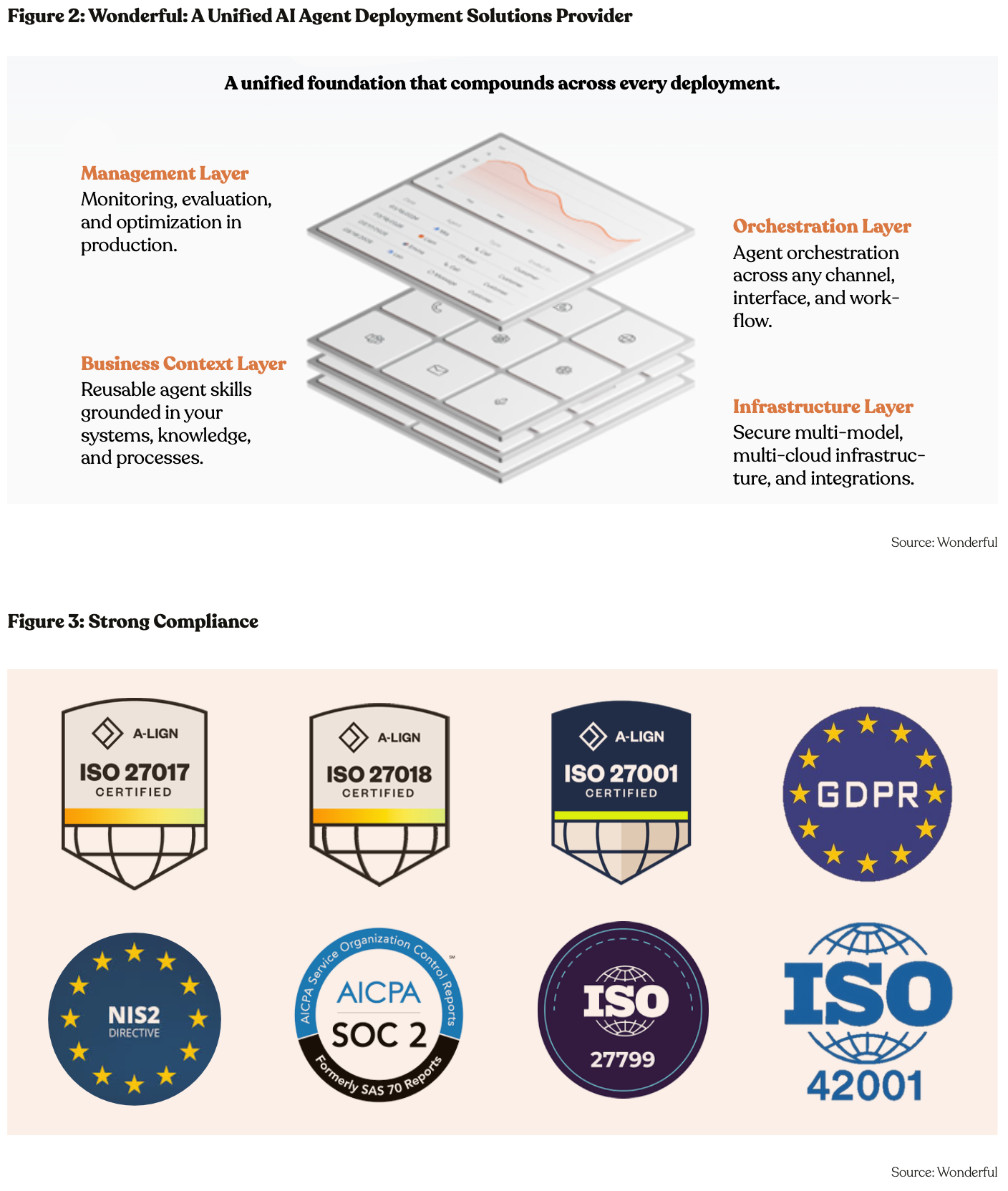
Wonderful AI also delivers enterprise-grade security and governance. The platform complies with leading industry standards and incorporates role-based access controls, comprehensive audit logging, and robust data privacy safeguards, enabling secure deployment across mission-critical environments.
Its agents are designed to act in complex operating environments, orchestrating workflows across channels, interfaces, and enterprise systems. Whether supporting customer-facing interactions or automating back-office processes, agents can operate seamlessly across functions and languages.
Unlike traditional decision-tree chatbots, Wonderful AI’s fully generative agents can reason through novel situations, manage exceptions, and dynamically adapt to context in real time. The platform supports deployment across web, mobile, voice, email, Slack, and any API-enabled environment, allowing organizations to build once and deploy universally.
The platform also offers significant execution depth. Agents can operate autonomously within dedicated environments, executing code, and maintaining context across long-running, multi-step tasks, enabling automation of complex workflows rather than isolated interactions.
Importantly, the value of the platform compounds over time. Each new use case expands the underlying knowledge base, integrations, and capabilities of the system, strengthening the shared infrastructure and making the entire platform progressively smarter, more capable, and more valuable across the enterprise.

Proven Product-Market Fit
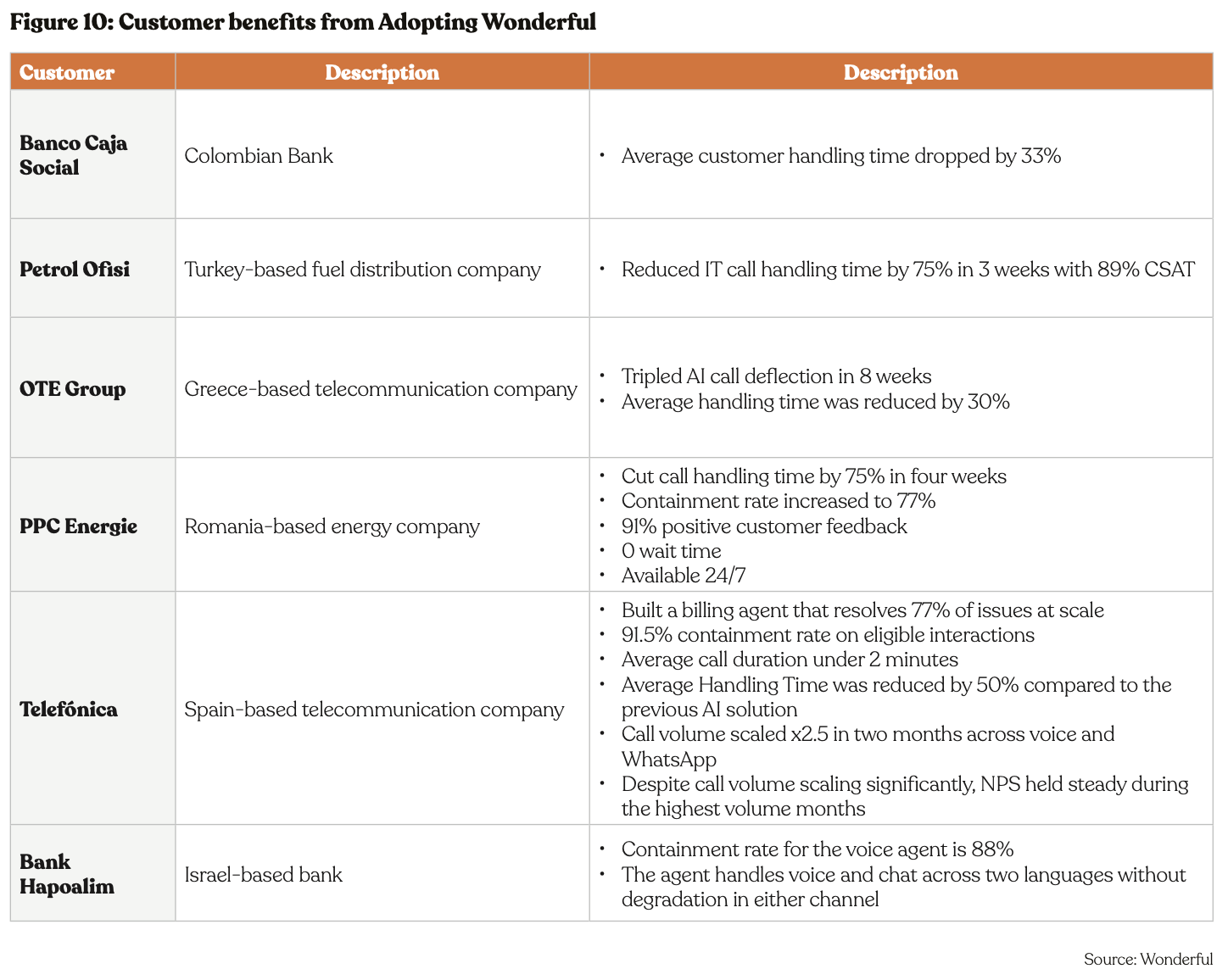
Wonderful has demonstrated strong product-market fit across multiple industries and geographies, with a proven ability to deliver measurable operational improvements at scale. The platform’s deployments across telecommunications, banking, energy, and fuel distribution companies consistently show significant reductions in call handling times, higher containment rates, and improved customer satisfaction outcomes.
Customers have realized substantial efficiency gains shortly after implementation. For example, Petrol Ofisi reduced IT call handling time by 75% within three weeks, while OTE Group tripled AI-driven call deflection and reduced average handling time by 30% in just eight weeks. Similar results were achieved by PPC Energie, which increased containment rates to 77% while eliminating wait times and maintaining 24/7 availability.
Wonderful’s ability to operate at enterprise scale is further evidenced by Telefónica, where the platform resolved 77% of billing-related issues, achieved a 91.5% containment rate on eligible interactions, and reduced average handling time by 50% compared to the incumbent AI solution. Notably, the company successfully scaled call volumes by 2.5x across voice and WhatsApp channels while maintaining stable customer satisfaction levels.
In highly regulated environments, Wonderful has also demonstrated strong performance. At Bank Hapoalim, the platform achieved an 88% voice-agent containment rate while supporting both voice and chat interactions across multiple languages without compromising service quality. For Banco Caja Social, the startup helped reduce average customer handling time by 33%.
Collectively, these customer outcomes highlight Wonderful’s ability to rapidly deliver operational efficiencies, improve customer experience metrics, and scale reliably across diverse enterprise environments, providing strong validation of its product-market fit.
Key Investment Concerns
Competitive Intensity and Execution Risk
Wonderful faces intense competition from global AI-agent platforms, contact-center automation vendors, CRM incumbents, and foundation-model companies. The company’s edge is localization, deployment depth, and enterprise integration which are hard to replicate. Rapid geographic expansion also creates operational complexity across languages, regulations, and support models, which the company is well-equipped to tackle.
While Wonderful operates in a rapidly expanding market, it faces competition from multiple directions, each with significant resources, established customer bases, and strong technological capabilities.
At the global level, AI-agent platforms are aggressively pursuing the same opportunity: enabling businesses to automate customer interactions through conversational AI. Many of these platforms already offer multilingual capabilities, workflow automation, analytics, and integration, making differentiation increasingly difficult. As the market matures, customers may view core AI-agent functionality as a commodity rather than a unique advantage.
Competition also comes from contact-center automation providers that have spent years building enterprise-grade solutions for customer service, voice operations, workforce management, and omnichannel engagement. These vendors already have deep relationships with large enterprises and may be able to layer generative AI capabilities onto their existing products, reducing the need for customers to adopt a separate platform.
CRM incumbents present another competitive threat. Major CRM platforms increasingly embed AI agents directly into customer support, sales, and marketing workflows. Since many enterprises already rely on these systems as their operational backbone, purchasing AI capabilities from an existing vendor can be easier, cheaper, and less disruptive than deploying a standalone solution. This creates a distribution advantage that newer entrants must overcome through superior functionality or a clearly differentiated value proposition.
Foundation-model companies represent a longer-term strategic risk. Providers such as OpenAI, Anthropic, Google, and others continue to move up the application stack by introducing tools, agent frameworks, multimodal capabilities, and enterprise-focused products. As these companies expand their offerings, some platform features that are currently differentiated may become available natively within the underlying AI ecosystems.
As a result, Wonderful’s long-term competitive advantage will depend on whether its strengths remain difficult to replicate. If its localization capabilities, regional language support, deployment expertise, workflow customization, and enterprise integrations create meaningful operational advantages, the company can establish defensible market positioning. However, if these capabilities become standardized across the industry, pricing pressure and customer switching risks could increase significantly.
Rapid geographic expansion introduces an additional layer of execution risk. Supporting multiple markets requires more than translating interfaces or deploying new language models. Each region may have unique customer expectations, cultural nuances, regulatory requirements, data residency rules, privacy standards, and procurement processes. Successfully operating across these environments demands substantial investment in infrastructure, compliance, partnerships, and local expertise.
Operational complexity also increases as the company scales. Maintaining high-quality support across dozens of languages, managing region-specific integrations, ensuring consistent service reliability, and coordinating distributed teams can place pressure on margins and execution. Growth may therefore require balancing market expansion with disciplined operational management to avoid compromising product quality or customer experience.
Ultimately, Wonderful’s success will depend not only on the strength of its technology but also on its ability to build durable competitive advantages, execute effectively across diverse markets, and maintain a pace of innovation that keeps it ahead of increasingly well-funded competitors.
Industry Overview
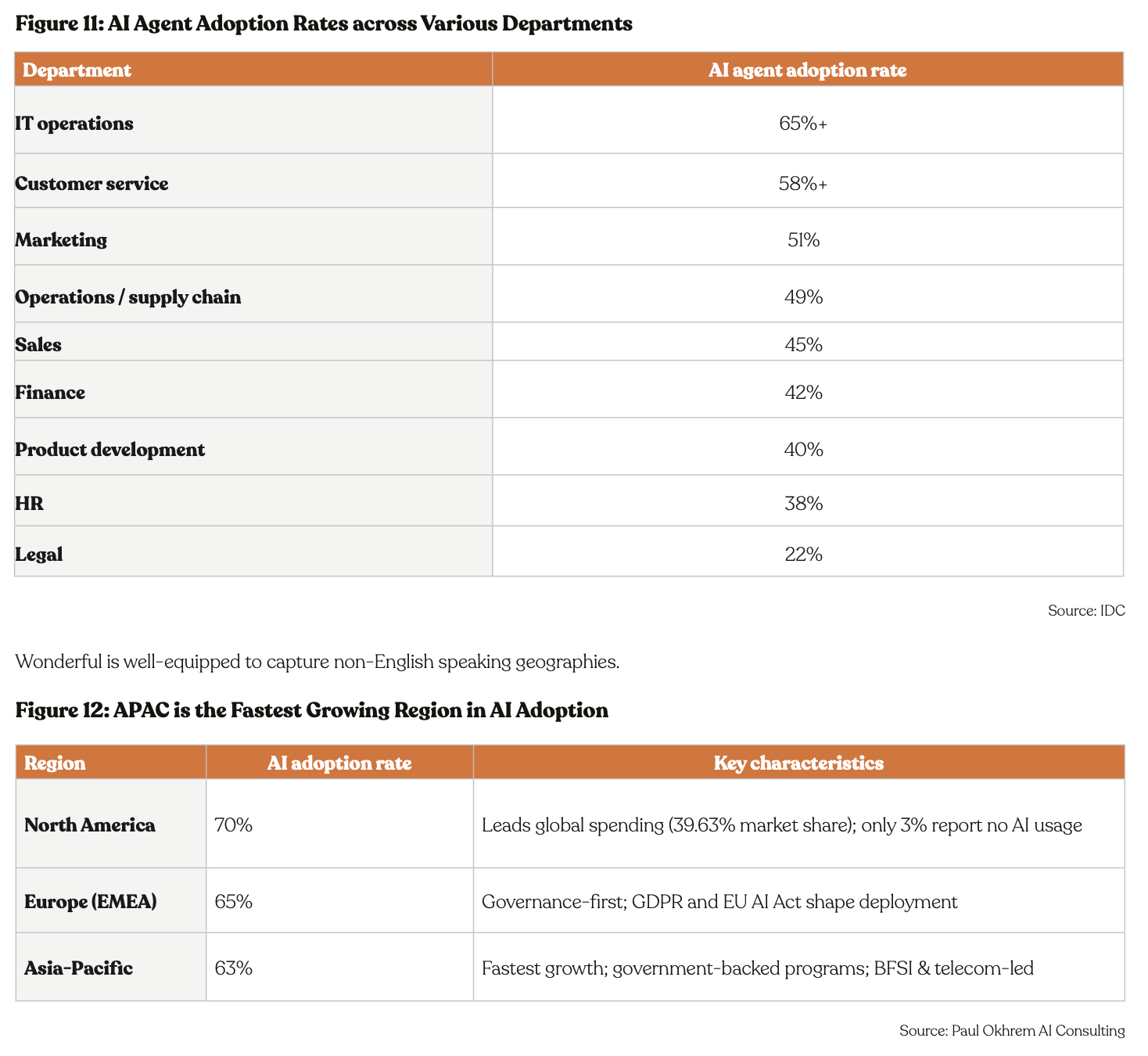
Wonderful is poised to benefit from the growing adoption of AI agents across various departments of enterprises.
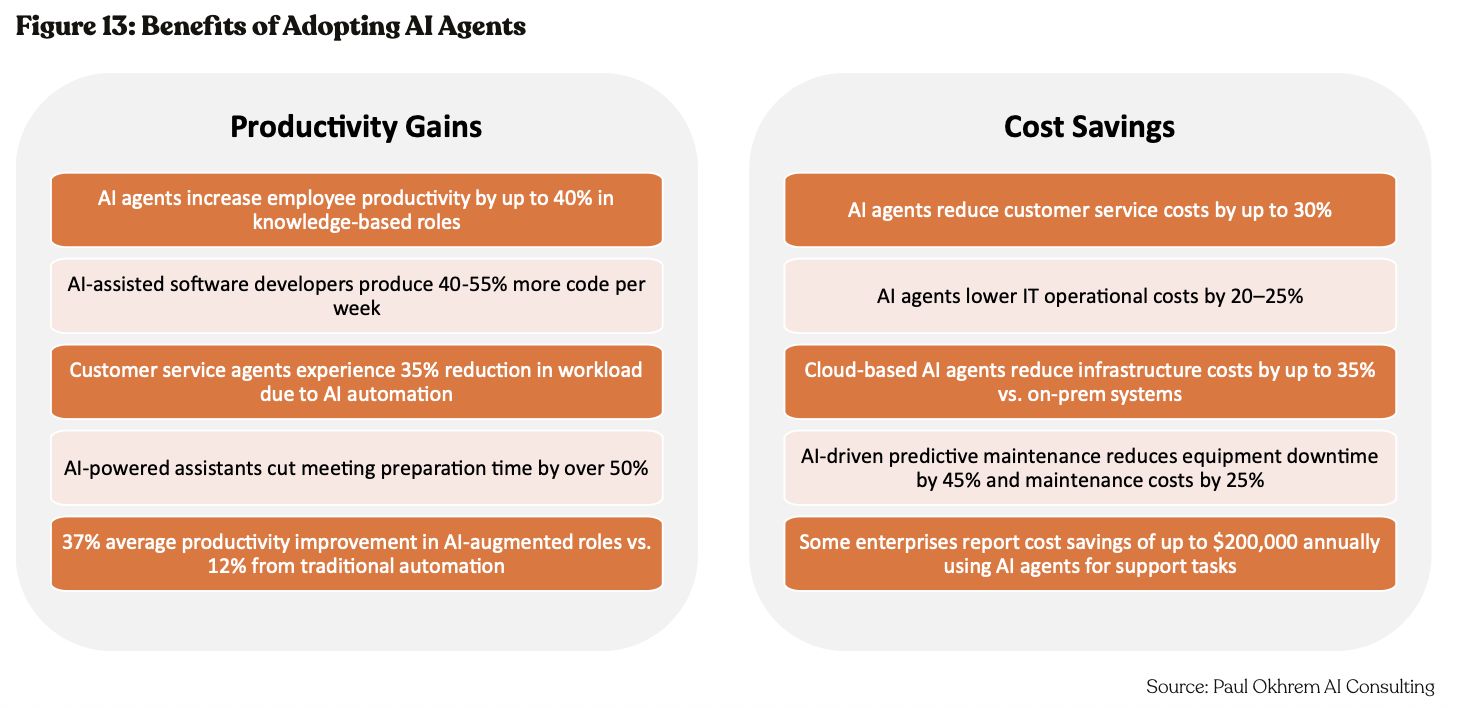
An AI agent may be performing exactly as designed, that is, fast, accurate, and always available. Yet it could still be losing customers on a scale for a simple reason: it speaks only one language. Most AI companies optimize for automation, efficiency, and cost reduction. Few ask a more fundamental question: Can their customers fully understand the AI?
That oversight has significant commercial consequences. According to CSA Research, 40% of customers are less likely to purchase when content is presented in a language other than their own. This means nearly half of the addressable market for a potential customer may disengage before meaningful interaction even begins, not because of product quality, pricing, or customer experience, but because of language.
For AI agencies and businesses deploying AI agents, this creates an invisible growth ceiling. For instance, consider a business with 1,000 potential customers per month at an average deal value of $500. This brings the monthly revenue potential to $500,000. If 40% of prospects do not convert due to language barriers, the business looses 400 customers or $2.4 million in a year.
The issue is not that the AI lacks intelligence. The issue is that it is not accessible to a large portion of the market. Language-driven revenue loss rarely appears as a clear signal. Instead, it manifests through lower conversion rates, higher abandonment rates, shorter customer interactions, and fewer closed deals.
Many teams respond by optimizing funnels, refining messaging, or increasing marketing spending. The root cause may be much simpler: customers cannot engage comfortably in the language they prefer.
The impact extends beyond 40% who leave immediately. Even among the remaining 60%, customers often expend additional effort to understand the conversation. Increased effort reduces trust, and reduced trust slows decision-making. This creates a second layer of conversion loss that most organizations never measure.
Customers do not buy products alone. They buy with confidence. Confidence is built through clarity, trust, and comfort. Language directly influences all three. When customers communicate in their native language, comprehension improves, hesitation decreases, and purchasing decisions happen faster.
This is reflected in broader consumer behavior as 76% of customers prefer buying in their native language, per CSA Research. This is not merely a translation challenge; it is also understanding the local culture and tone.
Only about 20% of the world’s population speaks English fluently. An English-only AI strategy effectively excludes most potential customers worldwide. As a result, growth is not simply limited, it is structurally constrained.
Most organizations focus on making AI smarter. An equally important question is whether the AI is accessible to the customers it is intended to serve. Expanding AI accessibility through multilingual, omnichannel engagement increases market coverage, improves conversion performance, and unlocks new revenue opportunities. The question is no longer whether your AI is intelligent. The question is: Is your AI understandable?
Financials
Revenue Outlook

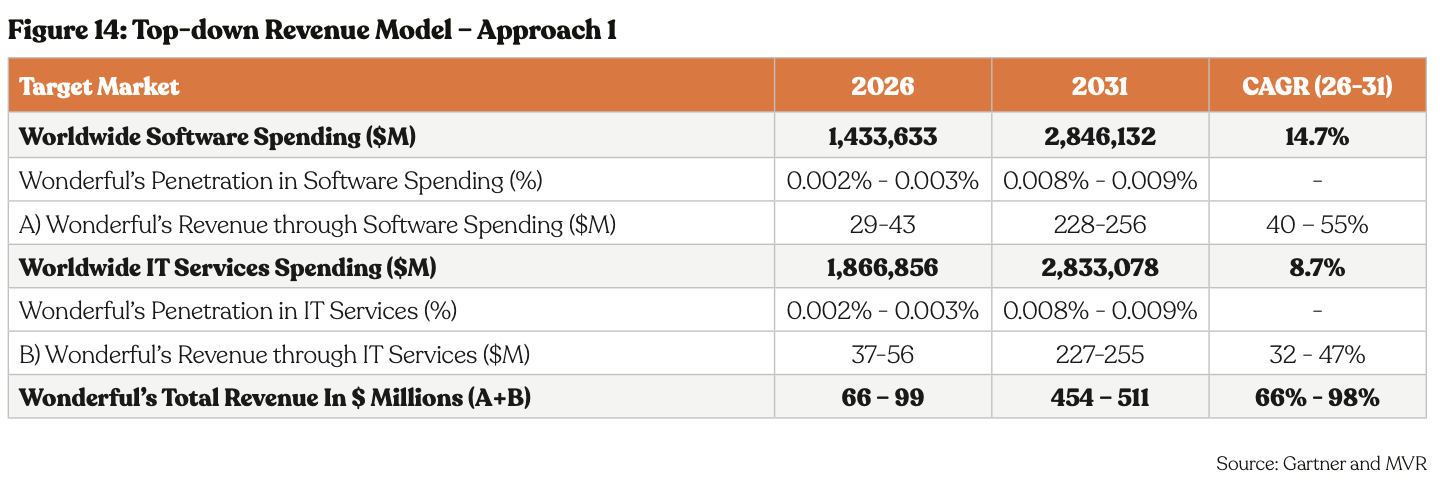
The revenue projections presented in this report represent MVR’s structured framework for evaluating Wonderful’s potential market penetration within the enterprise agent AI domain through 2031. These projections are estimates based on a top-down market share allocation model and should not be viewed as guaranteed outcomes. Our financial model integrates growth forecasts across two core addressable market segments, extrapolated from industry research data (Gartner):
• Worldwide Software Spending: Projected to expand from $1,249,509 million (2025) to $1,433,633 million (2026) at a YoY growth rate of 14.7%
• Worldwide IT Services Spending: Projected to grow from $1,717,590 million (2025) to $1,866,856 million (2026) at a YoY growth rate of 8.7%
MVR has applied a blended baseline market share assumption to these combined sectors. Our model assumes Wonderful captures an initial 0.002-0.003% market share in 2026, driven by a core focus on localized AI agents tailored for non-English customer services market. We project this market share could potentially scale to 0.008-0.009% by 2031, owing to the growing adoption of AI agents among enterprises across the globe. The projections presented here are intended as directional estimates for understanding the potential scale of opportunity Wonderful could capture by 2031. They offer a framework to think about how enterprise AI agent adoption may evolve and where Wonderful’s business could position itself within that trajectory. The market share percentages are subjected to our view of the industry.
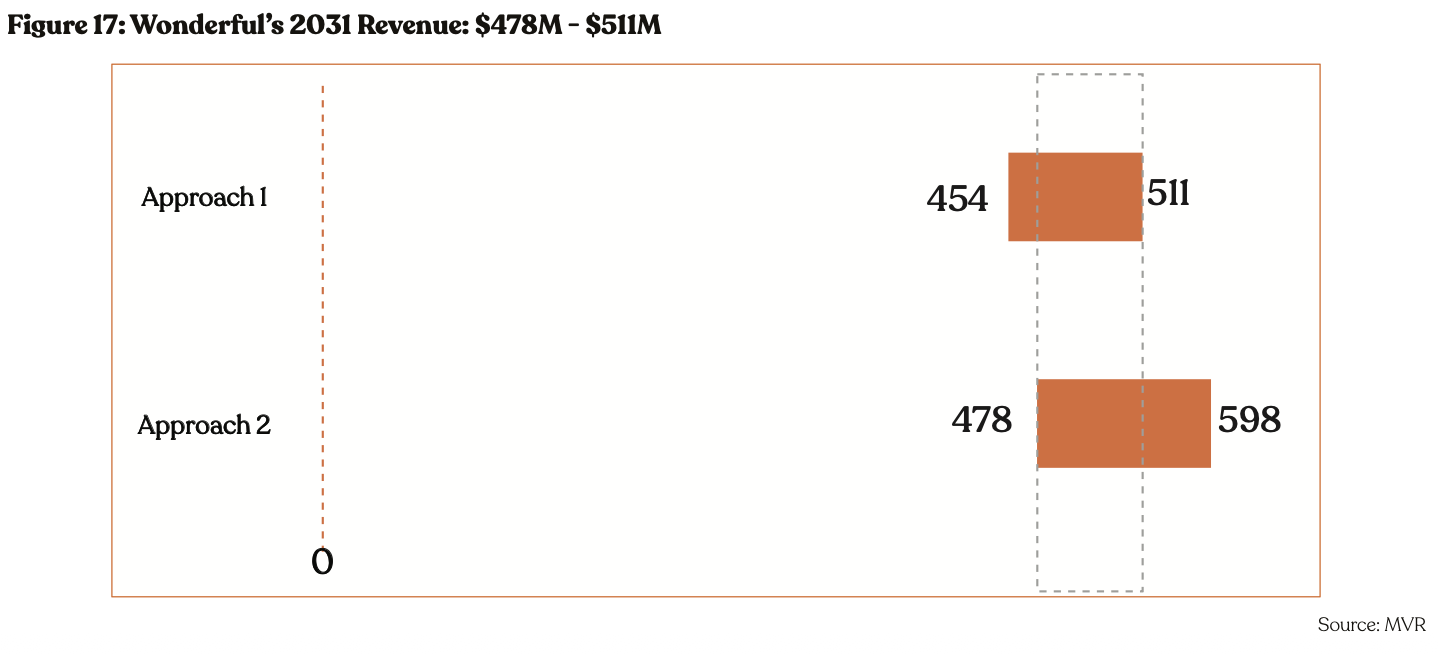
In the second revenue estimation approach, we use conservative ranges and explicit assumptions to trace sources of upside and downside. Our primary assumptions are that enterprise deployments per year will range from 200-400 in 2026 and 800-1,000 in 2031, reflecting an expectation that early pilots will convert into scaled enterprise rollouts as integration, trust, and use cases mature. For reference, the number of active AI agents in enterprises is projected to grow from 28.6 million in 2025 to 2.2 billion in 2030, per Statista. Revenue per deployment is modeled at $0.3 million in 2026 and rising to $0.5 million in 2031, based on Softteco data and SaaS inflation rate by Vertice. We model recurring usage revenue as an incremental stream driven by specialized AI workflows and expanded usage among existing customers, applying a 20% uplift on deployment-driven revenue to capture ongoing consumption and upsell potential. For 2026, deployment revenue is estimated at $52 million to $104 million, with recurring usage contributing $10 million to $21 million, producing a total revenue range of $62 million to $125 million. For 2031, deployment revenue is estimated at $399 million to $498 million, recurring usage at $80 million to $100 million, and total revenue between $478 million and $598 million.

Implied Valuation & Funding History
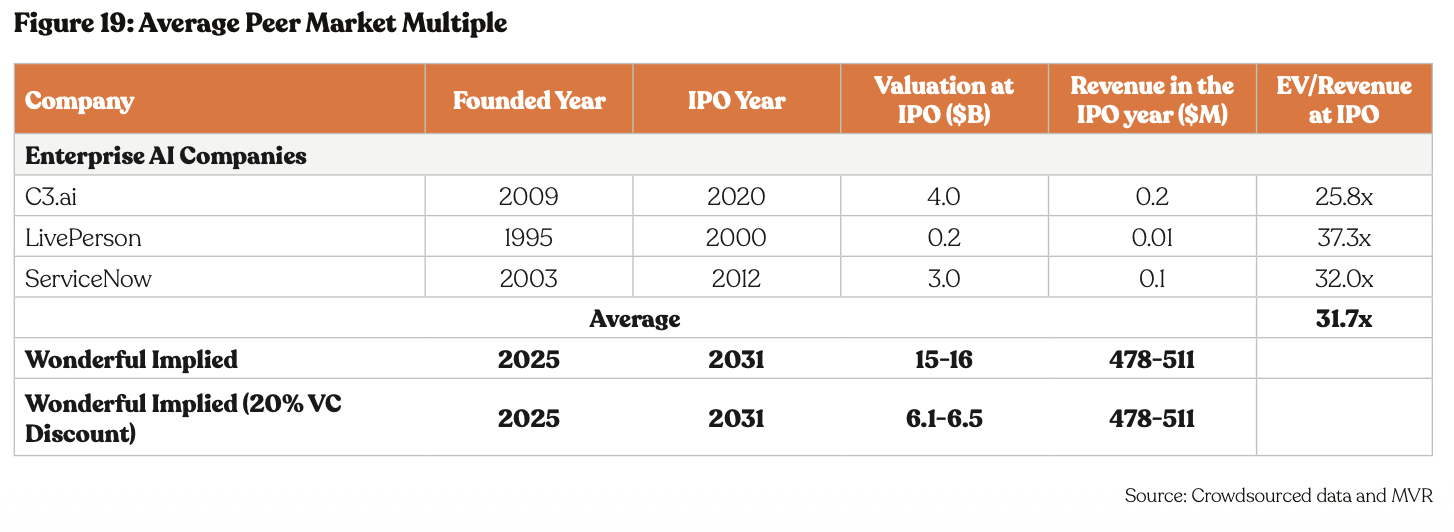
Wonderful currently lacks direct public market comparable; however, parallels can be drawn from established enterprise AI companies that have accessed public capital markets.
Among the most relevant comparable are C3.ai, LivePerson, and ServiceNow. C3.ai offers a platform for developing and deploying AI solutions across various industrial sectors, including oil and gas, manufacturing, and retail. LivePerson specializes in conversational AI and commerce software, while ServiceNow offers a natively integrated AI platform tailored for rapid deployment within enterprise workflows.
At the time of their respective initial public offerings, these companies were valued at $4.0 billion (C3.ai), $0.2 billion (LivePerson), and $3.0 billion (ServiceNow). Their annual revenues at that time were roughly $157 million, $10 million, and $90 million, respectively. These figures yield EV/Revenue multiples of 25.8x, 37.3x, and 32.0x. Averaging across these three data points produces an implied EV/Revenue multiple of approximately 31.7x.
Applying this to Wonderful’s revenue projections (MVR estimates), a valuation range of $15 billion to $16 billion is achieved for 2031. For a discount-to-present-value calculation, we apply a standard 20% venture discount rate, normalizing the valuation to $6.1 billion to $6.5 billion. In this context, an investment in Wonderful today could be roughly 3x - 3.3x by 2031, based on the current valuation of $2 billion.
Funding Rounds Summary
Wonderful has secured $299 million in funding across three funding rounds. Wonderful’s approach of customizable AI agents has attracted both customers and investors, leading to significant investor interest. Notably, the company raised $134 million in 2025. The company’s ability to attract investment has continued to grow, with its latest funding round, a $15 million series B-II in May 2026. Marquee investors in the startup include Index Ventures, Bessemer Venture Partners, Insight Partners, Institutional Venture Partners, and Vine Ventures, among others. The latest funding round valued the company at $2 billion.

Comparative Public Multiples
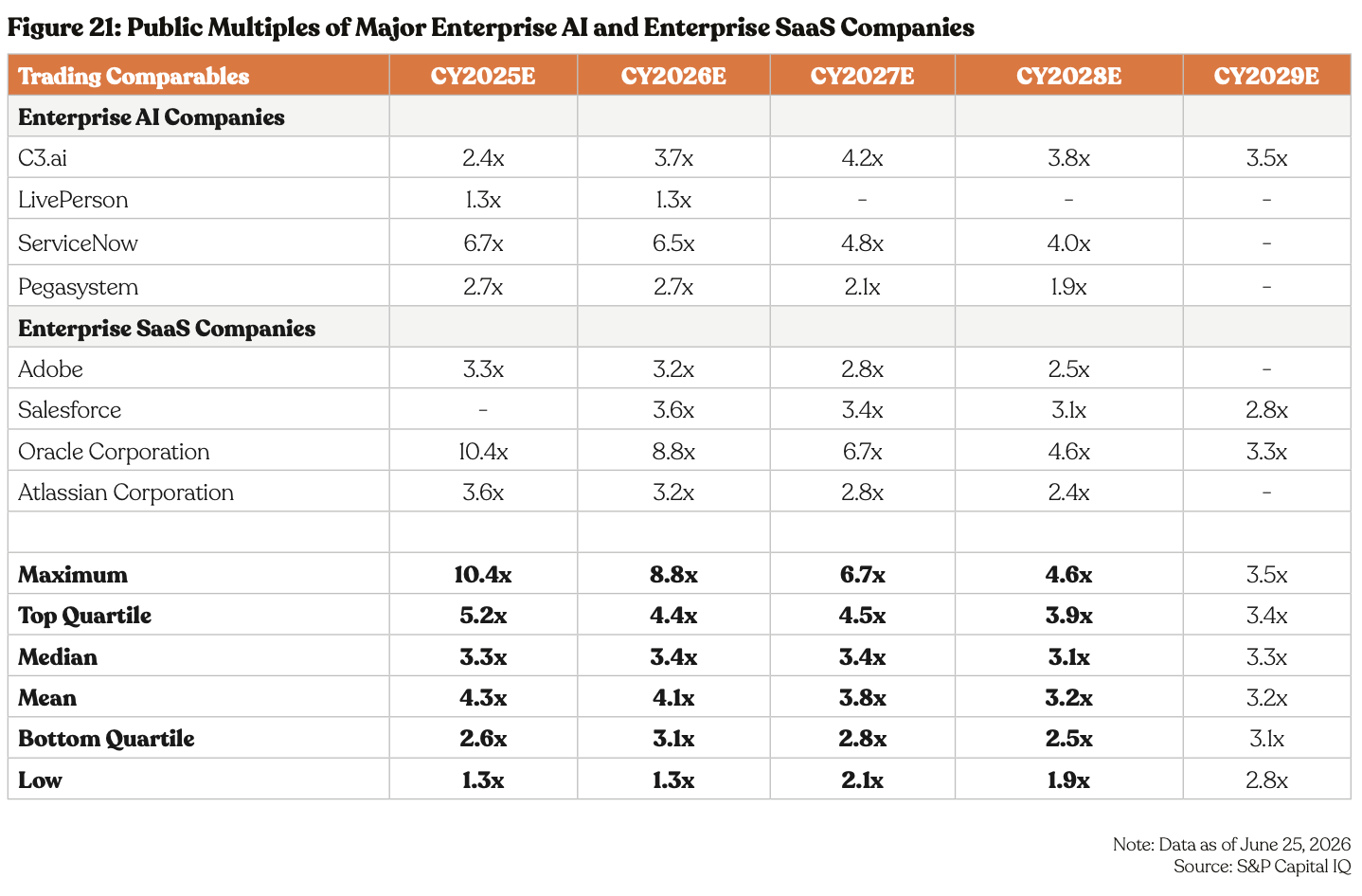
The table below shows valuation multiples for public companies in enterprise AI companies and enterprise SaaS companies. These public multiples provide a useful reference point for Wonderful’s future valuation. Given Wonderful’s localized AI agents, it is reasonable to expect the company to command a premium over its public peers.
About Manhattan Venture Partners
Our Research Methodology
Manhattan Venture Research provides clients with accurate, timely, and innovative research into the companies and sectors we cover. To that end, we have established an experienced team of analysts, researchers, economists, and industry veterans that focus exclusively on private companies with a proven track record of success. Producing quality research on a private company is uniquely challenging. Our analysts communicate with ex-employees, early investors, VCs, competitors, suppliers, and others to gather valuable information about the company under coverage. This information enables us to create unique financial models that value the underlying company and provide insight to our clients and industry experts, leveraging years of experience working for bulge bracket firms. Manhattan Venture Research reports include business and financial aspects of late-stage companies. These reports include but are not limited to industry overviews, competitor analysis, SWOT analysis, products (existing and in development), management and key directors, risks and concerns, other proprietary channels, historical financials, revenue projections, valuations (using various matrices and valuation recommendation), waterfall analysis, and a capitalization table.
Information Access Level Classification System (IALCS)
Manhattan Venture Research uses an Information Access Level Classification System (IALCS) to make clear the degree of access offered by the company(s) covered in all research reports.
Each research report is classified into one of three categories depending on its classification. The categories are:
I++: The company covered by the research report provided substantial disclosures to Manhattan Venture Partners.
I+: The report was prepared following partial disclosure by the company, including publicly available financial statements, and/or is based on conversations with past or present company employees.
I: All reports are prepared using a mosaic research approach. Not all companies are willing and able to provide substantive access to management and information. In I reports no direct access was granted.
About the Analyst
Santosh Rao has over 25 years of experience in equity research with a primary focus on the technology and telecom sectors. He started his equity research career at Prudential Securities and later moved to Dresdner Kleinwort Wasserstein, Gleacher & Co, and Evercore Partners, where he followed Telecom and Data Services. Prior to joining Manhattan Venture Partners, he was the Managing Director and Head of Research at Greencrest Capital, focusing on private market TMT research. Santosh has an undergraduate degree in Accounting and Economics, and an MBA in Finance from Rutgers Graduate Business School. While at Gleacher & Co he was ranked leading telecom equipment analyst by Starmine/Financial Times.
Copyright 2026 Manhattan Venture Research LLC. All rights reserved. Research is offered through VNTR Securities LLC.
What’s a Rich Text element?
Heading 3
Heading 4
Heading 5
The rich text element allows you to create and format headings, paragraphs, blockquotes, images, and video all in one place instead of having to add and format them individually. Just double-click and easily create content.
Static and dynamic content editing
A rich text element can be used with static or dynamic content. For static content, just drop it into any page and begin editing. For dynamic content, add a rich text field to any collection and then connect a rich text element to that field in the settings panel. Voila!
How to customize formatting for each rich text
Headings, paragraphs, blockquotes, figures, images, and figure captions can all be styled after a class is added to the rich text element using the "When inside of" nested selector system.
Ready to partner with MVP?
