POWER 2.0: Reimagining Power in the AI Age
Summary

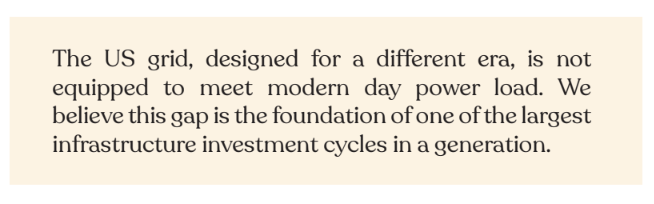
For two decades, US electricity demand was essentially flat. The exponential growth of AI has ended that. Datacenters, agentic workloads, and always-on inference have introduced a new class of industrial load that the existing grid was never engineered to serve. In our view, the gap between AI power demand and grid capacity represents a significant secular trend that may create potential investment opportunities across power infrastructure.
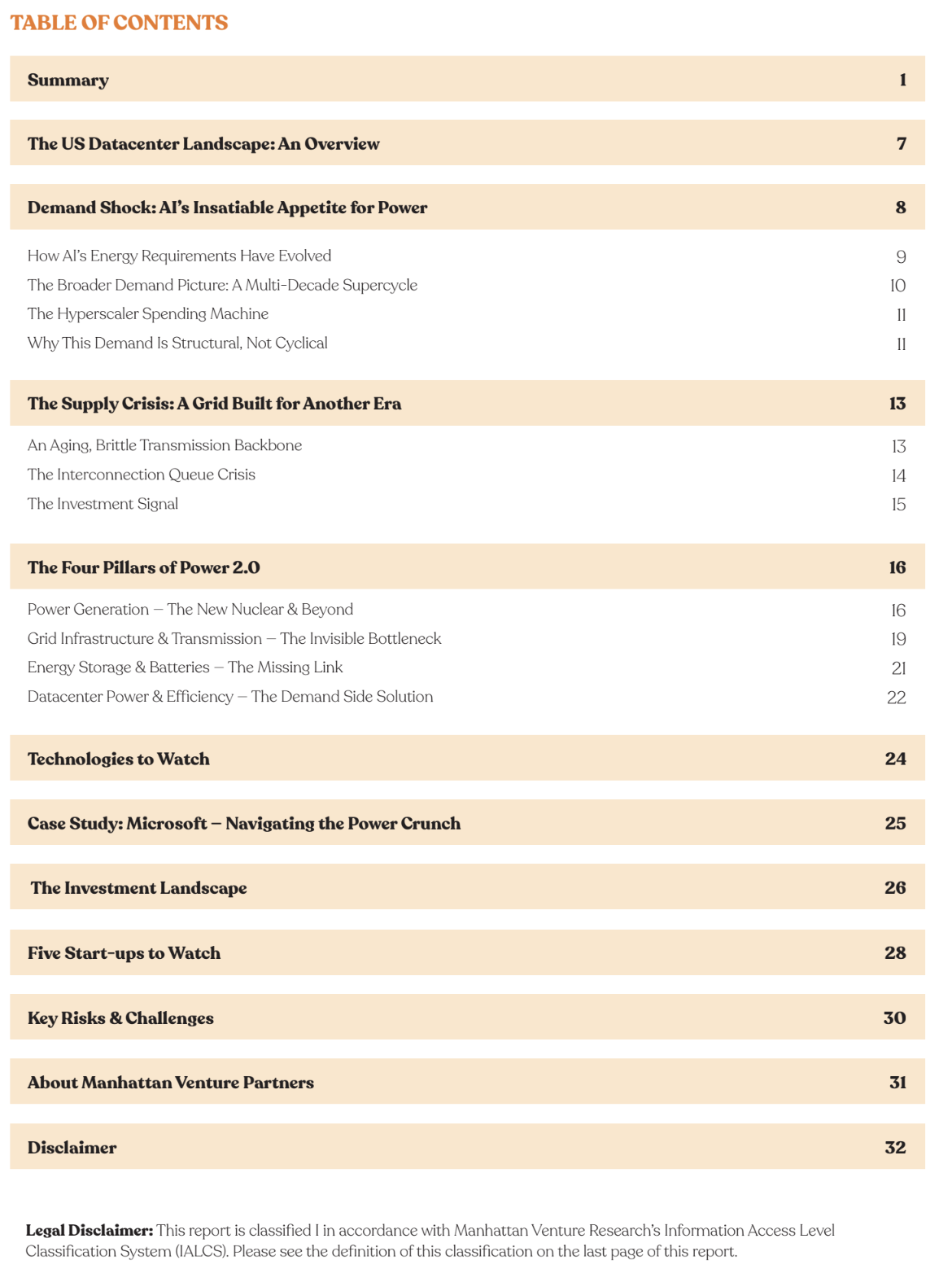
This report maps that opportunity. It opens by making the case that AI power demand is structural rather than cyclical, driven by forces such as inference compounding, agentic workflows, and the emerging physical AI frontier. It then examines the supply side of the equation, starting with an aging grid designed for a world of flat demand and predictable load, transformer backlogs, long interconnection queues, waiting for access that may not come for several years.
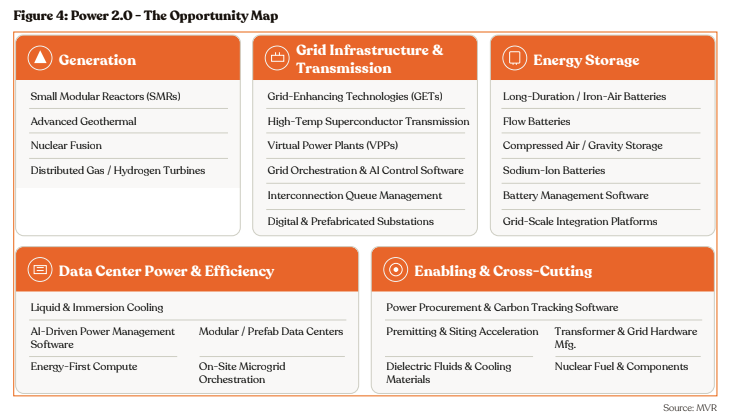
The key highlight of the report is its Four Pillars of Power 2.0 — (i) new power generation anchored by a nuclear renaissance and the rise of SMRs, (ii) grid infrastructure and transmission modernization, (iii) long-duration energy storage, and (iv) datacenter power efficiency, with a detailed look at the VC-backable categories within each. The report closes with an investment priority matrix, five high-conviction startups to watch, and a candid assessment of the risks that could narrow the opportunity.
Important Regulatory Disclosures
I, Santosh Rao, Head of Research, certify that: (1) All of the views expressed in this research report accurately reflect my personal views about the subject sectors, companies, and any associated financial instruments discussed herein; (2) No part of my past, present, or future compensation was, is, or will be directly or indirectly related to the specific views, projections, or opinions expressed by me in this research report.
Manhattan Venture Research is a wholly-owned subsidiary of Manhattan Venture Holdings LLC (“MVP”). MVP may currently and/or seek to do business with companies referenced in its research reports. As a result, investors should be aware that the firm may have a conflict of interest that could affect the objectivity of this report. Investors should consider this report as only a single factor in making their investment decision. This document does not contain all the information needed to make an investment decision, including but not limited to, the risks and costs.
Neither Manhattan Venture Research, VNTR Securities LLC, nor any of their affiliates or research analysts, beneficially own 1% or more of any class of common equity securities of any company specifically discussed in this report.
VNTR Securities LLC and its affiliates have not managed or co-managed a private placement or public offering of securities for any company specifically discussed in this report in the past 12 months, and have not received compensation for investment banking services from any such company in the past 12 months.
VNTR Securities LLC does not engage in any proprietary trading or act as a market maker in the securities of any company specifically discussed in this report.
Additional information is available upon request. Information has been obtained from sources believed to be reliable but Manhattan Venture Research or its affiliates and/or subsidiaries do not warrant its completeness or accuracy. The user is responsible for verifying the accuracy of the data received.
This material is not intended as an offer or solicitation for the purchase or sale of any financial instrument. The opinions and recommendations herein do not take into account individual client circumstances, objectives, or needs and are not intended as recommendations of particular securities, financial instruments, or strategies to particular clients. The recipient of this report must make its own independent decisions regarding any securities or financial instruments mentioned herein. Periodic updates may be provided on companies/industries based on company-specific developments or announcements, market conditions, or any other publicly available information.
This is a thematic industry research report covering the US power infrastructure and AI energy landscape. References to specific companies, including Kairos Power, Submer, VEIR, Commonwealth Fusion Systems, and Lightmatter, are illustrative of broader investment themes and do not constitute a solicitation to invest in those companies’ securities. Manhattan Venture Research LLC does not assign traditional equity rankings (e.g., “Buy,” “Hold,” or “Sell”) to the sectors or companies referenced in this report, nor does it employ a formal equity ratings system. Accordingly, no standardized distribution of ratings or corresponding investment banking relationships are provided.
Key Points
Traditional US Power Buildout Timelines Are Misaligned With AI-Driven Demand
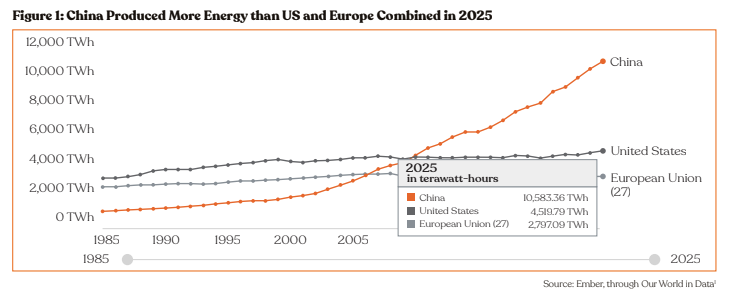
AI infrastructure is scaling in months, while generation, transmission, and system integration in the traditional sense are built over years and decades. That mismatch is becoming a national competitiveness problem. While the US leads in model quality, chip design, and datacenter density, China is quietly building cheap, abundant, always-on power. An AI model is only as powerful as the power behind it. If China closes the model gap while the US struggles to close the electricity gap, the innovation lead the US holds today diminishes.
No Single Technology Will Win the Power 2.0 Era
The AI-driven power demand is arriving faster than any single technology can scale to meet it. Accordingly, every serious power technology is getting pulled into commercial relevance simultaneously. SMRs for firm baseload, geothermal for 24/7 carbon-free, virtual power plants to unlock hidden capacity, advanced storage to firm up renewables. The race is not winner-takes-all.
Hyperscalers Are Functioning as Direct Power-Infrastructure Investors, Not Just Buyers
The Power 2.0 cycle is being financed differently from any prior energy transition. Rather than waiting for utilities to procure capacity through 7-10-year interconnection queues, hyperscalers are signing direct PPAs (Google with Fervo Energy and Energy Dome, Microsoft with the Three Mile Island restart), co-developing fleet agreements (Google’s 500 MW Kairos SMR order), and taking strategic equity in their suppliers (Microsoft in Helion, Amazon in X-energy, NVIDIA in Phaidra and Emerald AI).
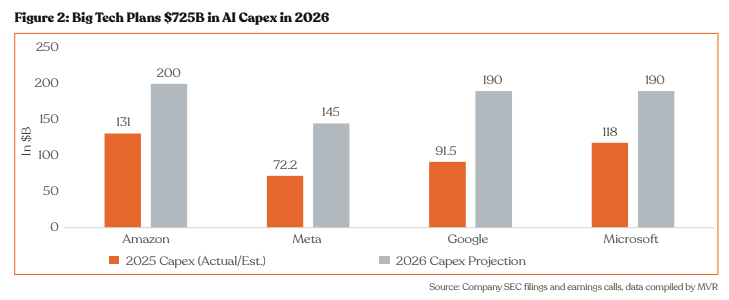
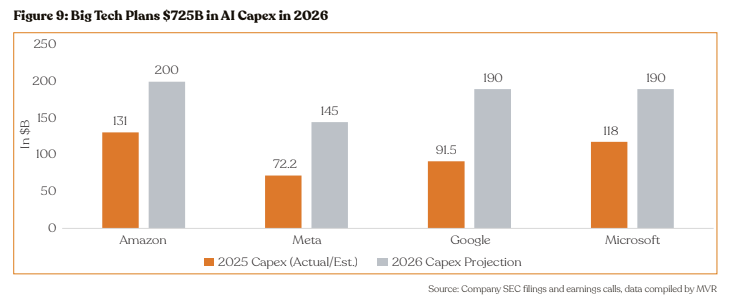
This pattern gives early-stage power technology the one thing it has historically lacked, a sophisticated demand-side counterparty willing to write 15-25-year commitments before commercial deployment. The structural consequence is that long-cycle infrastructure has become VC-relevant in a way it has not been for forty years. Collectively, Amazon, Microsoft, Meta, and Google are collectively planning up to $725 billion2 in capital expenditures in 2026.
A substantial and growing portion is being directed toward physical power infrastructure such as generation assets, distribution systems, and storage capacity, as hyperscalers increasingly conclude that grid-delivered power cannot meet their requirements on the timelines AI deployment demands.
Nuclear Is Moving From Policy-Driven to Demand-Driven Adoption
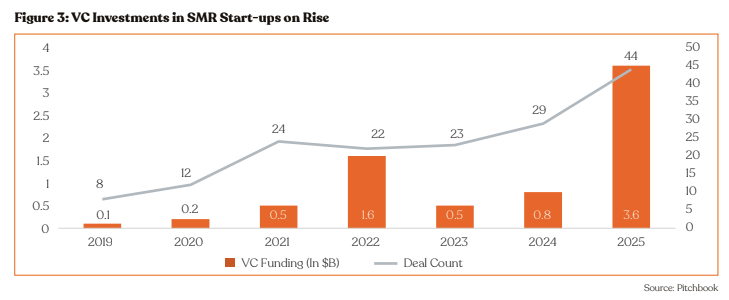
For four decades, nuclear energy’s fate was determined in legislatures and regulatory agencies. That era is over. The technology’s commercial renaissance is now being driven by customer urgency. Datacenters require power that is dense, continuous, and carbon-free, a combination nuclear can deliver at scale. Microsoft, Google, and Amazon have each made binding commitments to nuclear capacity not as a climate gesture but as an infrastructure decision. In addition to large scale nuclear facilities, small modular reactor (SMR) startups have been in limelight with VC investments surging more than 4x between 2024 and 2025.
Grid Orchestration and AI-Driven Control Software Offer the Fastest Path to Unlocking Stranded Capacity
The US does not just need more power; it needs smarter power. An estimated 10-40%3 of additional capacity can be unlocked from existing transmission infrastructure through software alone, without a single new wire. Grid orchestration platforms, AI-driven control systems, and virtual power plants are the fastest-deploying, lowest-capital tools in the Power 2.0 stack. With AI now accounting for 22% of all clean energy venture investment in 20244, and the VPP market projected to grow from $6.3 billion today to over $45 billion by 2035, this is emerging as a key category for investors.
Long-Duration Storage Is a Critical Component in the Energy Transition
Lithium-ion owns the sub-4-hour window. Everything beyond that, the multi-day renewable droughts, the winter demand spikes, the always-on AI loads, remains largely unsolved at commercial scale. Iron-air, flow, and next-generation chemistries are not incremental improvements on existing technology. They are the missing layer that turns intermittent generation into firm capacity.
The Picks-and-Shovels Layer Offers Attractive Pricing Power
Beneath the high-profile technologies lies a critical infrastructure layer comprising high-voltage cables, transformers, nuclear components, battery materials, and dielectric fluids used in immersion cooling. Every Power 2.0 deployment depends on these inputs, yet supply remains constrained. Multi-year transformer backlogs, limited HALEU availability for SMRs, and shortages of immersion cooling fluids highlight the imbalance. For investors, these enabling offer durable pricing power and lower technology risk, making them attractive complements to frontier investments.
Power 2.0 - Core Thesis
In 2026, the most advanced AI models are no longer gated by algorithmic progress or even access to GPUs. They are increasingly constrained by something far more fundamental — power. Training large-scale models, running persistent inference, and supporting always-on AI agents require a level of energy reliability and density that existing infrastructure was never designed to deliver.
What makes this moment investable is not just the surge in demand, but the mismatch it exposes. Power systems were built for a different world, one of predictable demand, centralized generation, and tolerance for intermittency. AI breaks all three assumptions. It introduces localized, continuous, and mission-critical energy demand that behaves less like traditional IT and more like industrial baseload consumption.
As a result, power is being redefined from a commodity input into a strategic control layer for the AI economy.
This report argues that we are entering “Power 2.0” — a new paradigm where energy systems become software-defined, intelligence-driven, and deeply integrated with compute infrastructure. In this world, the most valuable companies will not simply generate electricity, but also orchestrate it dynamically, reliably, and at scale. For investors, this creates a new class of venture opportunities at the intersection of energy, software, and infrastructure.
The US Datacenter Landscape: An Overview
The US is a global leader in datacenter infrastructure, supported by accelerating AI adoption, hyperscale cloud expansion, and rising enterprise demand for compute-intensive workloads. The country currently hosts approximately 4,2875 active datacenters, per Datacenter Map, representing the largest national datacenter footprint in the world. This scale advantage is increasingly becoming a strategic asset as AI models require unprecedented levels of compute, storage, networking, and power infrastructure.
The broader AI-driven datacenter economy is also entering a period of explosive growth. According to Research and Markets6, the global AI datacenter market is projected to expand from approximately $471.6 billion in 2026 to more than $2 trillion by 2032 with the US accounting for a major chunk of this growth. This growth is being fueled by rapid deployment of AI infrastructure, rising demand for GPU clusters, increasing enterprise AI adoption, and continuous investments from hyperscalers such as Microsoft, Amazon, Google, and Meta.
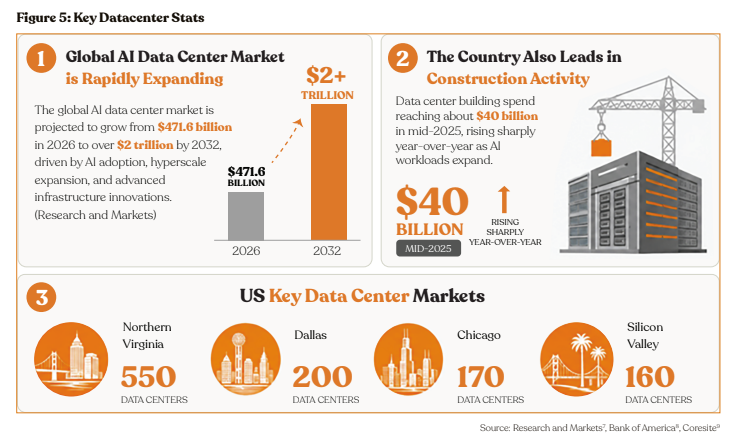
The US is also witnessing an aggressive construction cycle. Datacenter building spend reached nearly $40 billion by mid-202510, increasing sharply year-over-year as operators race to add new AI capacity.
However, infrastructure bottlenecks are beginning to emerge across power availability, permitting, cooling systems, transformers, and grid connectivity. Reflecting these constraints, Goldman Sachs Research11 estimates that only about 50-60% of planned datacenter capacity scheduled for the next one to two years is likely to come online on time, with delays and cancellations becoming increasingly common across major markets.
Demand Shock: AI’s Insatiable Appetite for Power
The explosive growth of foundation models, AI inference workloads, hyperscale cloud infrastructure, and GPU-intensive training clusters is fundamentally reshaping power consumption patterns across the US. What was once viewed as a gradual increase in digital infrastructure demand has now evolved into a full-scale energy shock driven by AI.
The impact is already visible at the national level. According to the International Energy Agency (IEA)12, US electricity demand grew approximately 2% in 2025, marking the second-fastest increase since 2000 outside of post-recession recovery periods. This acceleration is particularly notable because US electricity demand had remained relatively flat for much of the past two decades due to efficiency gains and slower industrial growth.
Datacenters sit at the center of this demand surge. Lawrence Berkeley National Laboratory13 estimates that US datacenter electricity consumption could rise from approximately 176 terawatt-hours (TWh) in 2023, representing about 4.4% of total US electricity consumption, to between 325 and 580 TWh by 2028. Under the high-end scenario, datacenters could account for as much as 12% of total US electricity demand within just a few years. This would represent one of the fastest infrastructure-driven increases in electricity consumption in decades.
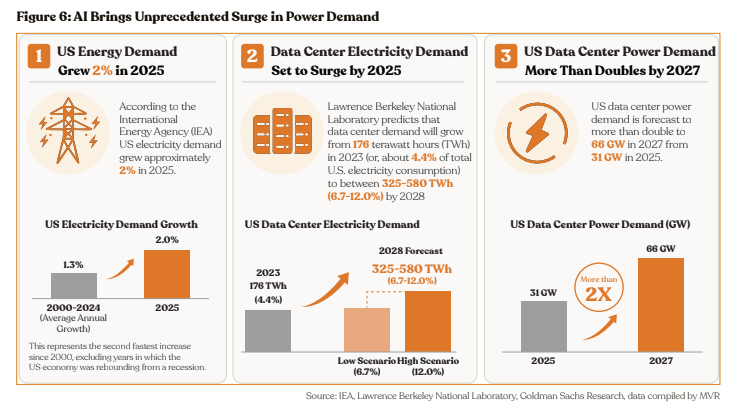
The scale of expansion becomes even more apparent when measured in power capacity. US datacenter power demand is forecast to more than double from approximately 31 gigawatts (GW) in 2025 to nearly 66 GW by 2027, per Goldman Sachs Research14. This surge is being driven not only by the construction of new hyperscale facilities, but also by the increasing power intensity of AI workloads themselves.
How AI’s Energy Requirements Have Evolved
Understanding why Power 2.0 is a structural imperative requires understanding how AI’s energy profile has changed across three dimensions: training, inference, and the emerging compute paradigm of reasoning and agentic AI. The trajectory is unambiguous. Efficiency per query is improving, but total energy demand is rising faster than efficiency gains can offset it.
Training
The energy required to train frontier AI models has grown by orders of magnitude in under a decade. Training GPT-2 in 2019 required a modest cluster of hardware running for days. Training GPT-3 in 2020 consumed approximately 1,287 MWh . By the time GPT-4 was trained, that figure had reached an estimated 50,000 MWh (50 GWh), a 3,875% increase from GPT-3. Each successive frontier model has required roughly 4-5x more compute than its predecessor, despite algorithmic and hardware efficiency improvements. Hardware efficiency is improving at 40% per year for leading AI GPUs , but this is being outpaced by the absolute growth in training scale. Epoch AI’s analysis projects that the largest individual frontier training runs in 2030 will likely draw 4-16 gigawatts of continuous power.
Inference
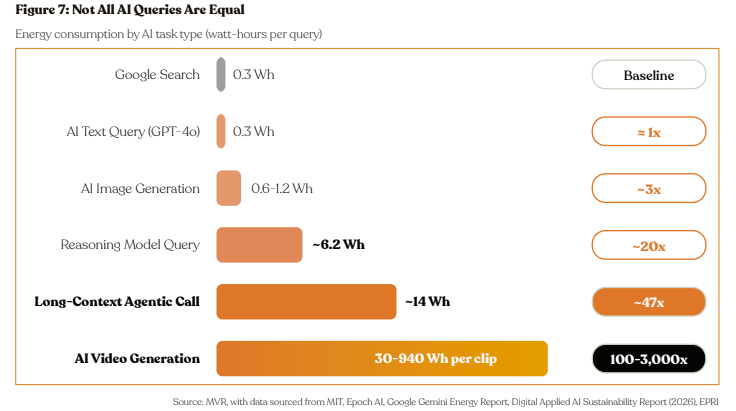
If training is the most visible energy event, inference is the one that compounds. Inference now accounts for an estimated 80-90% of total AI lifecycle energy consumption, and is growing 3-5x per year versus 1.5x for training. And while a standard AI text query uses roughly the same energy as a conventional Google search (~0.3 Wh), long context agentic calls and video generation requests uses manifold.
Reasoning, Agents, and Multimodal AI
Standard text inference is becoming more efficient. But the AI workloads of the next three years are not standard text inference. They are reasoning models, agentic workflows, long-context processing, and multimodal generation, each of which carries a dramatically higher energy profile.
Reasoning models consume 5-12x more energy than standard inference per query. A deep research query or reasoning trace averages approximately 6.2 Wh, versus 0.3 Wh for a standard text exchange. MIT Technology Review found that reasoning models require up to 43x more energy for simple problems, driven by the extended token generation required for chain-of-thought processing. Similarly, image generation consumes approximately 0.6-1.2 Wh per image at standard resolution. Video generation introduces a step-change with a low-quality short video output requiring approximately 30 Wh, while a higher-quality 5-second video demanding 940 Wh.
Agentic AI multiplies the energy burden further. Long-context calls (800K token context windows) average approximately 14 Wh per call, roughly 47x a standard short text query. As enterprises deploy AI agents to automate business processes, each “task completed” represents a compute footprint orders of magnitude larger than single-turn user prompt.
The Broader Demand Picture: A Multi-Decade Supercycle
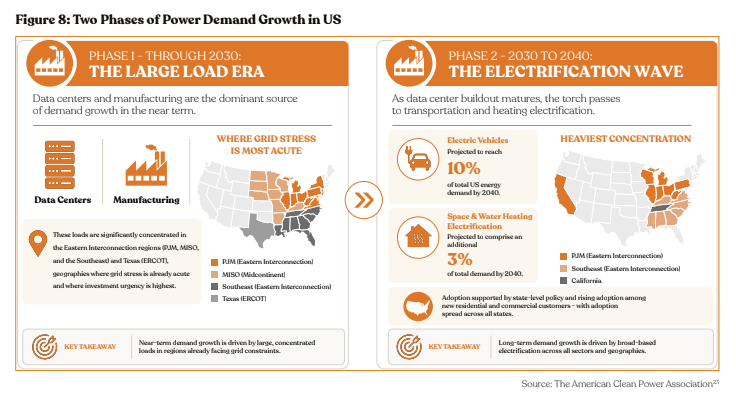
The AI-driven surge does not exist in isolation. It is the leading edge of a multi-decade demand supercycle with several reinforcing drivers. Between 2024 and 2040, electricity demand in the US is expected to grow by 35–50%, driven by a combination of underlying economic growth, large industrial loads from datacenters and manufacturing, and the electrification of transportation and heating.21 The diversity of these drivers and their sequencing points to sustained, structural demand growth, not a single-cycle event.
The growth unfolds in two distinct phases.
The Hyperscaler Spending Machine
Amazon, Microsoft, Meta, and Google are collectively planning up to $725 billion in capital expenditures in 2026, approximately $100 billion above the guidance these same companies issued just one quarter prior. The upward revision reflects not a change in strategy but an acceleration in demand that has consistently outpaced internal projections.
What makes this spending cycle particularly remarkable is that the dominant force is now AI infrastructure. Hyperscalers are racing to secure compute capacity, electricity access, networking equipment, advanced cooling systems, and semiconductor supply chains at unprecedented scale. In many cases, the bottleneck is no longer capital availability, but the physical ability to build fast enough.
Importantly, hyperscaler spending is also cascading across the broader industrial economy. Every new AI-focused datacenter drives secondary demand for power generation, transformers, switchgear, cooling technologies, fiber connectivity, construction services, backup power systems, and specialized real estate. This has created a powerful multiplier effect across sectors that historically operated far outside the traditional technology ecosystem.
Why This Demand Is Structural, Not Cyclical
Skeptics point to potential AI efficiency gains, models like DeepSeek demonstrated that capability improvements could reduce per-task compute requirements. But the structural case for sustained demand growth rests on three durable forces that efficiency gains alone cannot offset.
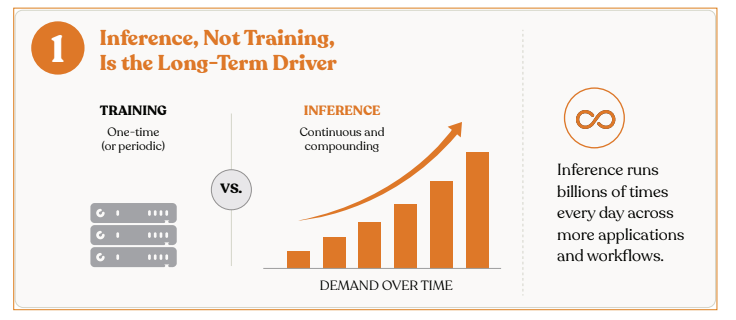
First, inference, not training, is the long-term demand driver. Model training is a one-time (or periodic) event. Inference, running AI models billions of times per day across enterprise applications, consumer products, autonomous agents, and physical AI systems, is continuous and compounding. As AI penetrates more workflows, the cumulative inference burden grows faster than efficiency improvements can reduce it.
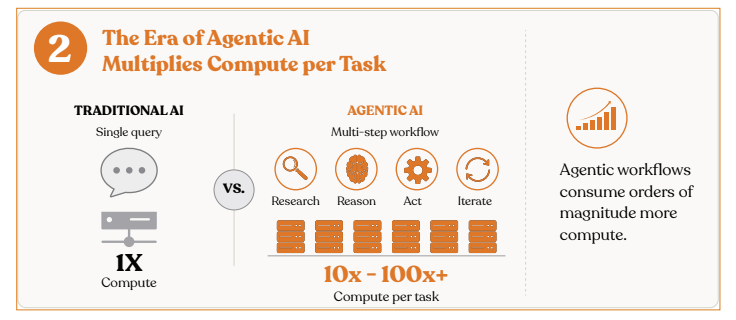
Second, the era of agentic AI multiplies compute per task. Traditional AI answered a query. Agentic AI executes multi-step workflows, researching, reasoning, acting, and iterating. Each agentic task consumes orders of magnitude more compute than a single model call. As enterprises move from AI experimentation to AI deployment at scale, compute intensity per business outcome rises.
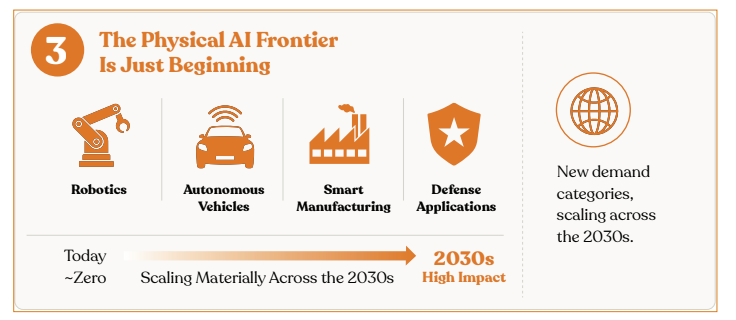
Third, the physical AI frontier is just beginning. Robotics, autonomous vehicles, smart manufacturing, and defense applications represent demand categories that are effectively zero today but will scale materially across the 2030s, all running on datacenter and edge infrastructure that requires power.
The Supply Crisis: A Grid Built for Another Era
The demand side of the Power 2.0 story is easy to see. The supply side is harder to see, because it is defined by what is not being built. A grid designed in the mid-20th century now has to absorb 21st-century load growth, and every structural feature of that grid (its age, its regulatory architecture, its financing model, its queuing mechanics), was engineered for a world of flat demand, predictable load, and incremental expansion.
This section unpacks why the supply response is so slow, and why that slowness is itself the investment opportunity. Every year of delay on the public grid pushes more capital toward private, onsite, and software-driven solutions that can move faster.
An Aging, Brittle Transmission Backbone
Many components of the US electric grid date back 40 to 70 years24, well beyond their intended lifespan. The American Society of Civil Engineers has rated25 US energy infrastructure at “D+” in its most recent scorecard, and the Department of Energy has repeatedly warned that the aging grid poses both a reliability risk and a national security risk.
The brittleness is not theoretical. Summer heat events in Texas and California have forced rolling blackouts. Winter Storm Uri in 2021 caused over $130 billion in losses and more than 200 deaths26. In July 2024, Northern Virginia27 voltage fluctuation disconnected 60 datacenters simultaneously, creating a 1,500 MW power surplus that forced emergency grid adjustments. Each incident underscores the same point: the physical hardware and the regulatory machinery around it were not designed for the loads they now carry.
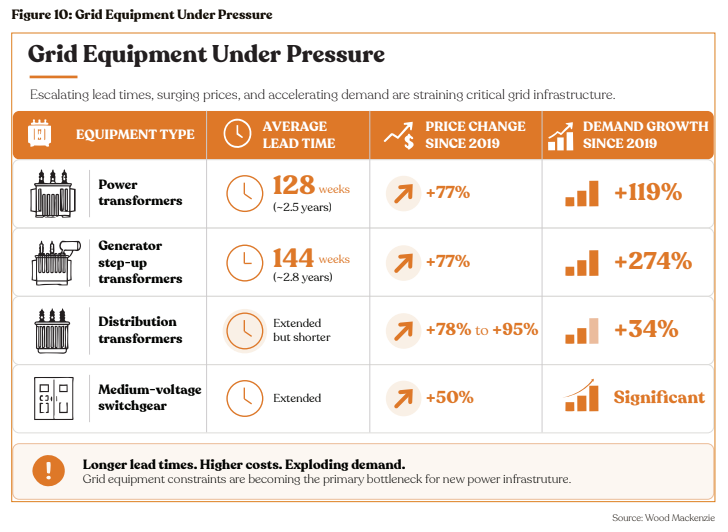
One of the clearest stress points is the transformer market. Power transformer lead times have now stretched to approximately 128 weeks28, while generator step-up transformers (GSUs), critical for connecting power generation assets to the grid, average roughly 144 weeks. These timelines have become increasingly problematic as utilities, hyperscalers, and industrial developers race to secure electrical infrastructure capacity.
At the same time, transformer pricing has surged. Prices for power transformers have increased approximately 77% since 2019, driven by rising demand, labor shortages, manufacturing bottlenecks, and constrained access to raw materials. One particularly important vulnerability lies in grain-oriented electrical steel (GOES), the specialized material required to manufacture high-efficiency transformers. Cleveland-Cliffs currently remains the only domestic producer of GOES in the United States, highlighting the narrowness of the domestic supply chain supporting critical grid infrastructure.
Demand growth is also dramatically outpacing manufacturing expansion. Demand for generator step-up transformers has risen approximately 274% since 2019, far exceeding any meaningful increase in production capacity. As a result, industrial developers increasingly report that equipment availability, rather than financing or permitting, has become the primary bottleneck delaying new projects. In effect, the limiting factor is no longer whether companies want to build, but whether the physical components required to energize projects can be secured in time.
The situation is further complicated by America’s dependence on overseas supply chains. Roughly 80% of large power transformers used in the United States are imported, exposing critical infrastructure deployment to geopolitical risks, trade disruptions, shipping delays, and broader global manufacturing constraints. As AI infrastructure investment accelerates, this dependence is becoming an increasingly important strategic vulnerability.
Taken together, these constraints suggest the next phase of the AI infrastructure race may not be determined solely by semiconductor leadership or model capabilities, but by the ability to modernize and scale the physical electrical backbone underpinning the digital economy. In many ways, the grid is emerging as the new choke point of the AI era.
The Interconnection Queue Crisis
In ERCOT, 198 GW of large load applied for interconnection in the first quarter of 2026 alone29, with 86 GW of new load requests currently under review, roughly equivalent to the system’s existing peak load. ERCOT is tracking more than 438 GW of large-load requests30, and nearly 90% are from datacenters. PJM, meanwhile, is facing a projected capacity shortfall that could reach 15 GW by 203031 as electrification and AI-driven load growth outpace new generation additions.
The queue is not just long; it is structurally broken. Speculative projects crowd out viable ones, restudies are triggered by every withdrawal, and the cost-allocation rules that determine who pays for network upgrades are so contested that they routinely end in multi-year legal proceedings. FERC Order 2023 attempts to reform this by replacing the first-come-first-served queue with a first-ready, first-served cluster study process, but regional implementation is slow, and relief will not be visible in project completion numbers before the late 2020s.
For the investment case, the queue is the clearest possible evidence that public grid capacity cannot match the pace of AI demand. Every hyperscaler investment in direct interconnect, behind-the-meter generation, and onsite microgrids is a vote that the queue will not resolve in time.
The Investment Signal
The supply crisis is not a temporary disruption that will resolve through routine capital cycling. It is a structural condition of the US grid, and it is getting worse before it gets better. Three implications flow directly from that fact:
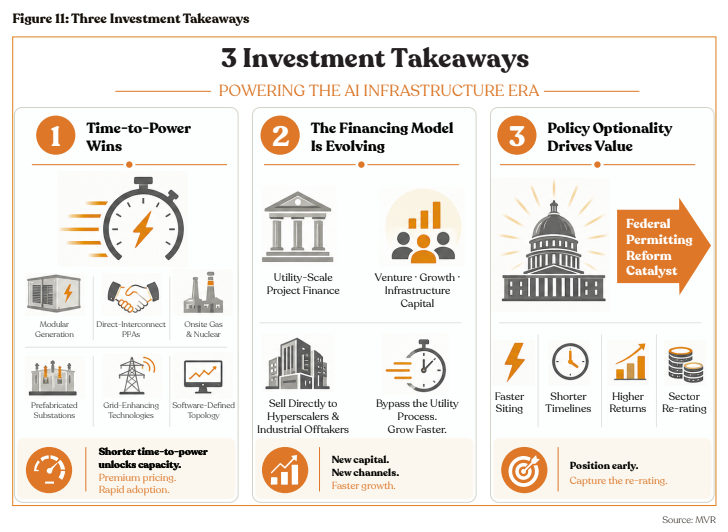
First, anything that shortens time-to-power is disproportionately valuable. Modular generation, direct-interconnect PPAs, onsite gas and nuclear, prefabricated substations, and any technology that unlocks capacity from the existing grid (grid-enhancing technologies, software-defined topology) will earn premium pricing and rapid adoption.
Second, the financing model is shifting from utility-scale project finance toward a broader mix of venture, growth, and infrastructure capital. Companies that can sell directly to hyperscalers and industrial off takers, bypassing the traditional utility procurement process, can grow much faster than the regulated sector.
Third, policy optionality matters more than it usually does. A meaningful federal permitting reform package would act as a general repricing event for the sector. Investors who build positions before that catalyst, in categories that structurally benefit from faster siting, will capture most of the re-rating.
What’s a Rich Text element?
Heading 3
Heading 4
Heading 5
The rich text element allows you to create and format headings, paragraphs, blockquotes, images, and video all in one place instead of having to add and format them individually. Just double-click and easily create content.
Static and dynamic content editing
A rich text element can be used with static or dynamic content. For static content, just drop it into any page and begin editing. For dynamic content, add a rich text field to any collection and then connect a rich text element to that field in the settings panel. Voila!
How to customize formatting for each rich text
Headings, paragraphs, blockquotes, figures, images, and figure captions can all be styled after a class is added to the rich text element using the "When inside of" nested selector system.
Ready to partner with MVP?
