
Venture Bytes #131: AI That Builds AI is the Next Frontier

AI That Builds AI is the Next Frontier
A handful of brand-new start-ups just raised billions to bet on entirely new ways AI can learn, improve, and understand the world. If successful, these approaches could mark a meaningful shift, moving beyond today’s heavy reliance on large-scale human-generated data toward systems that generate intelligence more directly through interaction, simulation, real-world feedback, and autonomous self-improvement.
Anthropic co-founder Jack Clark recently gave this shift a striking timeline. He estimated a ~60% chance that by the end of 2028 (and 30% by end of 2027), we’ll see AI systems capable of autonomously building better versions of themselves with no humans in the loop. The Anthropic Institute's new research agenda openly describes "AI contributing to speeding up the research and development of AI itself" as a first-order priority.
Clark cites two specific data points to anchor the 60%. On a standard benchmark of AI fixing real-world software bugs (SWE-Bench Verified), frontier models went from 2% in 2023 to 93.9% in May 2026. On the length of a coding task an AI can complete on its own, the figure went from 30 seconds in 2022 to roughly 12 hours today, with the doubling time shortening from every seven months to every four.
Two weeks before Clark made that prediction, Sequoia and Lightspeed led a $1.1 billion seed round into Ineffable Intelligence, a start-up founded by ex-DeepMind researcher David Silver. Ten days before that, GV and Nvidia put $500 million into Recursive Superintelligence, the four-month-old Palo Alto company built by ex-Salesforce chief scientist Richard Socher with Tim Rocktäschel and a small group from OpenAI and DeepMind. Together: $1.6 billion in two weeks, at a combined valuation of $9.1 billion, into companies that have not shipped a product. Both are explicit about what they are trying to build: not the next foundation model, but the system that builds the foundation model.
The current paradigm, where large language models are pre-trained on the public web and post-trained with reinforcement learning from human feedback, has three structural limits. The first is data. Epoch AI's most recent projection estimates that the global stock of high-quality public text is sufficient to train compute-optimal models up to roughly 5×10²⁸ floating-point operations (FLOP), a level expected to be reached around 2028. Synthetic data, multi-epoch training, and aggressive filtering have stretched the timeline; they have not removed the ceiling. A model that learns by imitating human-generated text has, by construction, a knowledge frontier that ends where the human frontier ends.
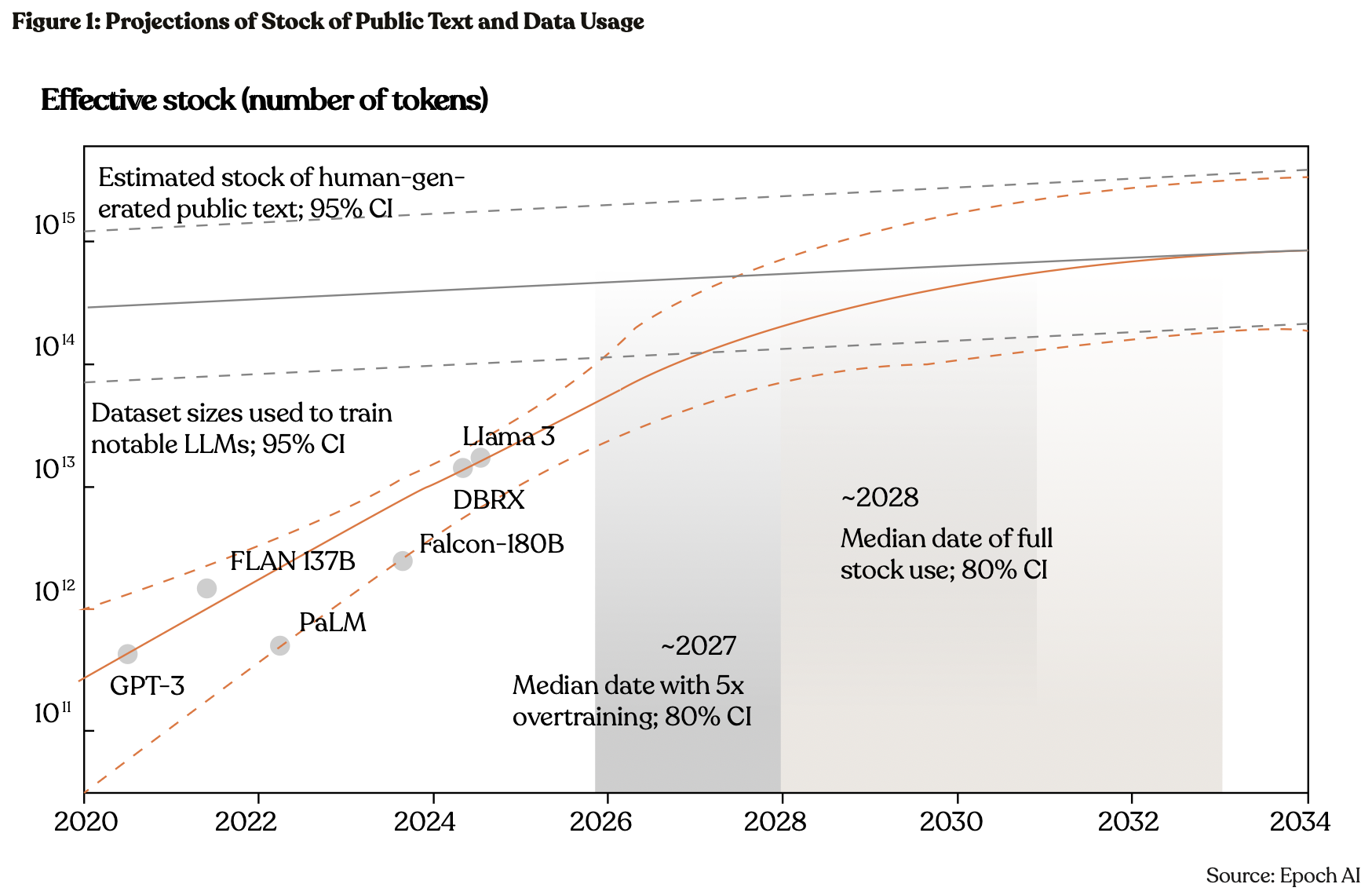
Projection of effective stock of human-generated public text and dataset sizes used to train notable LLMs. Individual dots represent dataset sizes of specific notable models. The dataset size projection is a mixture of an extrapolation of historical trends and a compute-based projection that assumes models are trained compute-optimally.
The second is the human bottleneck. Pre-training scales with compute. RLHF scales with compute and with humans. RLAIF and Constitutional AI reduce the human dependency but do not eliminate the human bottleneck on quality validation. Every frontier model release in 2025 and 2026 has had at least one step (principle design, red-teaming, eval validation) that paused for human work. A loop that required human validation runs at human speed, regardless of what the chips beneath it can do.
The third is the creative ceiling. A model trained on the median of human written output regresses toward the median of human written output. Frontier reasoning emerges from RL post-training, not from imitation. Anthropic's public framing has, over the last twelve months, shifted with less emphasis on pure scaling, more on new training objectives, new evaluation environments, new reward structures.
The bet underneath all of this is that the next decade of progress will not be a continuation of the last one. Accordingly, new startups are coming up with new approaches. Founded in 2025, Ineffable Intelligence aims to discover knowledge and skills purely through reinforcement learning from its own experience in rich environments. The company was founded by David Silver, the creator of AlphaGo and AlphaZero, the systems that reached superhuman play in Go and chess without ever studying a human game. AlphaGo Zero played 4.9 million games against itself in three days and beat the version of AlphaGo that had defeated Lee Sedol.
Ineffable plans to use the RL, self-play, and no human data beyond board games to math, code, and ultimately science. An agent that generates its own experience does not run out of it. In April 2026, Ineffable raised a $1.1 billion seed round at a $5.1 billion post-money valuation from investors including Sequoia, Lightspeed, Nvidia, Index Ventures, and Google.
Founded in late 2025, Ricursive Intelligence is building the recursion at the hardware layer – AI that designs better chips, and those chips, in turn, train better AI that designs even better chips. The company was founded by Anna Goldie and Azalia Mirhoseini, the two Google researchers behind AlphaChip, the AI system that produces chip floor-plans in hours which traditionally take human designers more than a year, and which Google has used to design four successive generations of its TPU accelerators. Ricursive's bet is to industrialise that approach. It wants to build the platform that runs the recursive design loop end-to-end, across every stage of the semiconductor process.
In December 2025, Ricursive raised a $35 million seed round led by Sequoia at a $750 million valuation. Two months later, it raised a $300 million Series A at a $4 billion post-money valuation — less than 60 days post-launch. Lightspeed led the Series A, with participation from Sequoia, DST Global, Nvidia's NVentures, Felicis Ventures, Radical AI, and 49 Palms Ventures.
Finally, AMI Labs is building world models — AI systems that learn from video, sensor data, and physical interaction rather than from descriptions of the world written down by humans. The bet is that a system that can predict the next frame of physical reality has, by construction, internalised causality, geometry, and physics in a way no language model can. In March 2026, AMI raised a $1.03 billion seed round at a $4.5 billion post-money valuation.
If even one of these bets works, the payoff could be enormous. It can unlock unprecedented efficiency in critical areas such as new drug discovery, clean energy breakthroughs, advanced materials, and scientific research at large. That said, significant challenges remain. These start-ups are very early-stage efforts, pre-product in most cases. Pure reinforcement learning, while spectacular in closed-rule environments like games, faces a vastly more difficult leap when applied to open-ended, messy domains like science and the real world.
Yet regardless of whether these labs deliver full breakthroughs or merely valuable incremental advances, they are already pushing the entire AI ecosystem to explore new frontiers in how intelligence can be created, not just scaled.
Space-based Solar Technology Has Caught a Bid
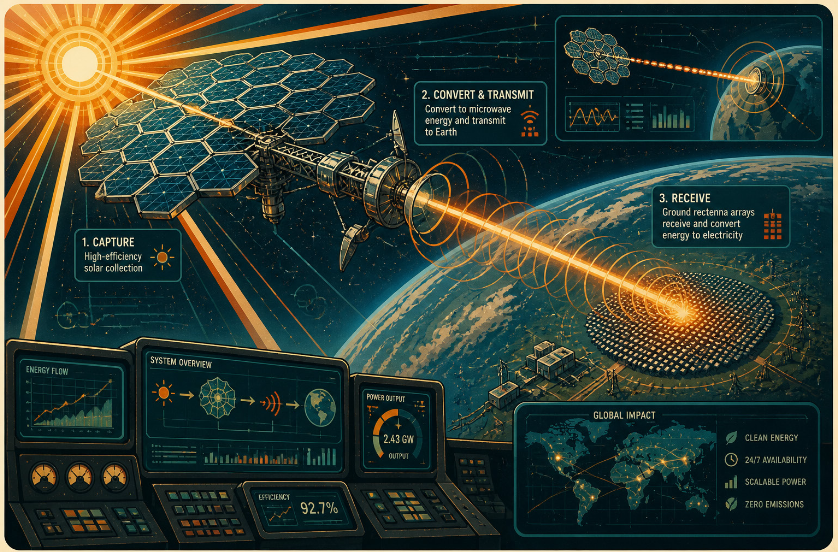
The modern space race is increasingly about ambitious projects such as space data centers and lunar settlements. But beneath all the ambition sits a critical question: who powers it all? Space-based solar power (SBSP) is increasingly emerging as one possible answer, not to just orbital data centers but also to growing power needs of terrestrial data centers.
Recently, Meta announced a deal to reserve up to 1GW of space-based solar power from Overview Energy, a four-year-old start-up based in Virginia. It is the first time a major cloud company has signed a real contract for an idea that has existed only in physics papers and Department of Defense studies since the 1970s. The deal gives Meta early access to capacity from a planned constellation of solar-collecting spacecraft, with commercial power delivery beginning as soon as 2030.
Meta is not the only one scrambling to secure enough power for AI. Big Tech companies are pursuing almost every possible energy source, from renewables and nuclear to gas-powered plants and small modular reactors, to support growing data center demand. Amazon, Meta, Google, and Microsoft collectively signed roughly half of all global clean-energy PPAs in 2025, according to
BloombergNEF. Traditional grid expansion is struggling to keep pace with AI demand, while interconnection queues at grid operators such as ERCOT, PJM, and MISO already stretch into multiple years.
The basic idea behind SBSP is older than most people realize. What has changed is that launch economics, hardware efficiency, and power-transmission technology are finally beginning to align with the vision. To understand why, it helps to look beyond headline cost estimates. A2024 NASA report concluded SBSP would deliver electricity at $610-$1,590 per MWh, roughly 12 to 80 times more expensive than ground-based alternatives.Meanwhile, Frazer-Nash Consultancy, performing a similar analysis for the UK government, estimated a much lower central cost of £62/ MWh, or about $78/MWh. The difference largely came down to one critical assumption: specific mass, or how much hardware must be placed in orbit to generate one kilowatt of usable power.
That metric matters most because every extra kilogram launched into geostationary orbit directly increases system cost.Today’s flight-proven space solar arrays weigh roughly 33 kg per kilowatt. The best next-generation designs demonstrated so far are closer to 5 kg per kilowatt. Holding everything else constant, that change alone reduces the cost of placing hardware in orbit from roughly $66,000 per kilowatt to closer to$10,000 per kilowatt.
What Changed
Three things shifted in the last eighteen months that the older economic studies could not yet reflect. First, the physics is no longer the open question. In 2025, Japan’s JAXA-led team demonstrated wireless microwave power transmission from space to Earth, and Caltech’s MAPLE experiment had already shown the same thing in 2023. By late 2025, Star Catcher Industries, a Florida-based start-up beamed 1.1 kW across 100 meters at NASA’s Kennedy Space Center, breaking DARPA’s prior 800-watt record. While the scale and pointing accuracy still remain challenges, technology has been proven already.
Second, launch cost stopped being the main barrier. Every SBSP economic study published before 2024 used launch costs that Starship is on track to undercut by ten times or more. NASA’s own sensitivity tables show that combining lower launch costs ($500/kg with volume), electric in-space propulsion, longer hardware lifetimes, and modest manufacturing scale brings SBSP cost down to $40-$80/MWh, the range where it competes with ground-based solar plus batteries. SpaceX is now flight-testing Starship Version 3, rated for 100+ tons to low-Earth orbit. The conservative case in the NASA report has become the realistic case.
Third, there is finally a customer willing to pay for extreme energy solutions. That has triggered an aggressive hunt for entirely new power sources. AI infrastructure is reshaping energy demand curves far faster than utilities can respond. Meta and others are already committing to massive renewable deployments, nuclear agreements, and unconventional power strategies simply to secure future capacity. In that environment, space-based solar no longer feels like a technology searching for a market.
But this is also where the conversation needs to become more grounded. The real question is not whether SBSP sounds futuristic or technically possible. It is whether there are specific markets where the economics actually make sense. SBSP is not going to beat ground-based solar plus batteries on cost per MWh by 2030, and possibly not by 2035. The investor case is not selling cheap bulk power. It is three narrower markets: round-the-clock power for cloud data centers that already pay $80-$120/MWh for reliable clean electricity; defense and remote-base power where running grid lines is impossible and diesel costs $1,000+/MWh once delivered; and power for satellites themselves, where every satellite is short on electricity and customers have no alternatives. A start-up that wins any one of these markets does not need to match ground-grid prices to make money for its investors.
A small but increasingly credible ecosystem of start-ups is now forming around those opportunities. Some companies are trying to beam energy from orbit directly to Earth. Others are building orbital systems that extend solar generation hours or provide power to satellites already in space.
Backed by Prime Movers Lab, Engine Ventures, and EQT Foundation, Overview Energy is one of the most ambitious companies in the category because it is directly targeting Earth’s power grid. Its satellites would collect solar energy in space and beam it down using lasers to existing solar farms, avoiding the need to build entirely new grid infrastructure.
Founded by Robinhood co-founder Baiju Bhatt, Cowboy Space (formerly Aetherflux) is taking a very different approach from most space-based solar start-ups. Instead of mainly trying to send power back to Earth, the company wants to use that energy directly in orbit to run AI data centers in space. The idea is simple: if cloud companies cannot get enough electricity or grid access on Earth, move some computing closer to the power source itself. Its long-term vision combines rockets, satellites, solar power, and AI infrastructure into a single system.
Founded in 2024, Star Catcher Industries is focused on a more immediate market: powering satellites already operating in orbit. The company raised $88M total, including a $65M Series A earlier this month. Star Catcher doesn't beam power down to Earth at all. It beams power between satellites. Its orbital "power node" satellites can deliver up to 10x more electricity to a customer satellite's existing solar panels. The customer doesn't have to change anything on their own hardware. The buyer is anyone who operates satellites including commercial, defense, or government entities. The company has $60M in signed contracts already with $3B in claimed future deals and is the fastest path to revenue in the SBSP space.
What’s a Rich Text element?
Heading 3
Heading 4
Heading 5
The rich text element allows you to create and format headings, paragraphs, blockquotes, images, and video all in one place instead of having to add and format them individually. Just double-click and easily create content.
Static and dynamic content editing
A rich text element can be used with static or dynamic content. For static content, just drop it into any page and begin editing. For dynamic content, add a rich text field to any collection and then connect a rich text element to that field in the settings panel. Voila!
How to customize formatting for each rich text
Headings, paragraphs, blockquotes, figures, images, and figure captions can all be styled after a class is added to the rich text element using the "When inside of" nested selector system.
Ready to partner with MVP?
