Venture Bytes #133: The AI Race Is Becoming a Cost Race

The AI Race Is Becoming a Cost Race
For the past three years, the AI race has been defined by one question: Who has the smartest model? Every major release from OpenAI, Anthropic, Google, and xAI has been judged by benchmark scores, reasoning ability, and coding performance. Everyone assumed that the best model would capture most of the value.
That assumption is beginning to break down. Not because the models have stopped improving, but because enterprises are finally confronting the true cost of using them at scale.

The numbers coming out of enterprises are striking. Individual power users are generating API bills of up to $35,000 a month. Companies that enthusiastically rolled out multiple internal AI tools are now consolidating them to control costs. An analysis by UBS found that nearly 60% of enterprises reviewing their AI budgets are actively moving toward lower-cost models. Even infrastructure is becoming a constraint. Google reportedly capped Meta’s access to Gemini after demand exceeded available compute capacity.
And this is before the real explosion. Today’s AI usage is still dominated by chatbots. Tomorrow’s AI usage will be driven by agents. Unlike chatbots, AI agents don’t stop after generating a response. They execute multi-step workflows, calling tools, writing code, validating outputs, and iterating until the job is done. A single workflow can consume orders of magnitude more tokens than a chat session. Goldman Sachs Research estimates that token usage from AI agents could increase 24-fold by 2030.

Against that backdrop, the economics of AI are changing just as quickly as the technology itself. DeepSeek first challenged the assumption that frontier-level reasoning had to come with frontier-level costs. Zhipu AI's GLM 5.2 pushes that narrative further by delivering near-frontier performance on agentic coding benchmarks while remaining significantly cheaper than leading proprietary APIs. At the same time, frontier labs are responding with aggressively priced offerings such as GPT-4o mini, Claude Haiku, and Gemini Flash.
As token consumption explodes, cost becomes a competitive advantage. For many enterprises, a small trade-off in performance is worth a dramatic reduction in operating costs. While the most demanding workloads, from scientific research to complex software engineering, will continue to rely on the front models for the best available intelligence, enterprises are likely to adopt a barbell strategy. Low-cost models will be used for routine, high-volume tasks and frontier models for complex, high-value work. The objective shifts from maximizing intelligence to maximizing intelligence per dollar.
That seemingly small shift changes the architecture of enterprise AI. Organizations will no longer build around a single model provider. They will build systems that continuously evaluate price, latency, accuracy, and reliability before deciding which model should handle each request.
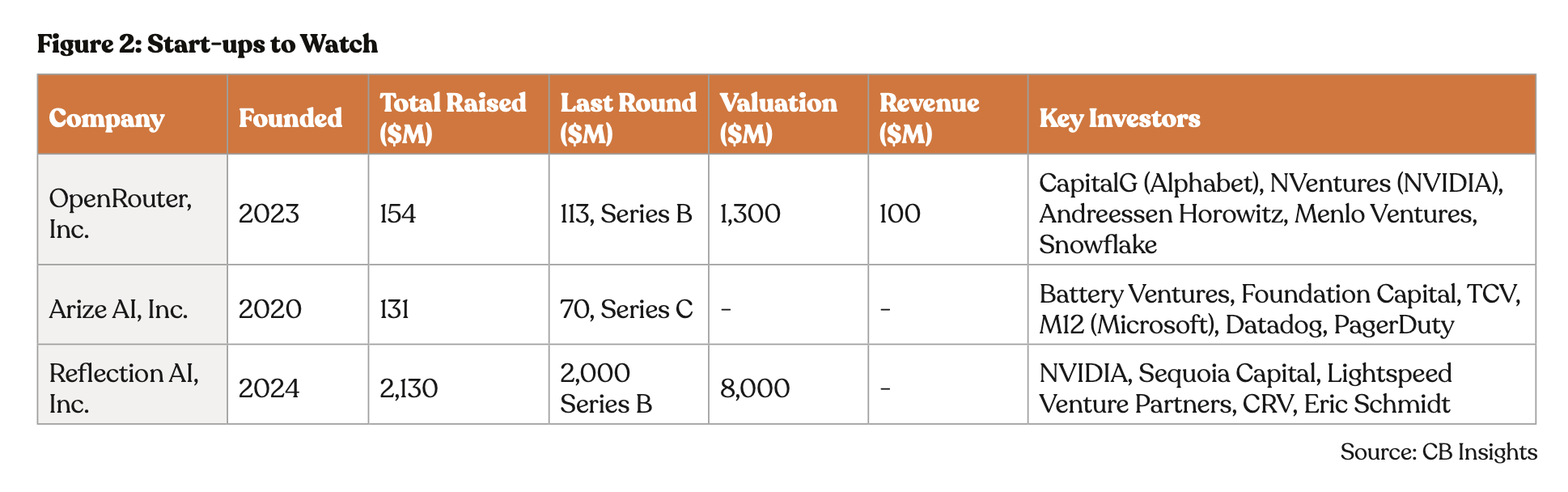
Three emerging segments stand out as particularly well positioned to benefit from this transition.
- Model Routing
As enterprises move beyond a single AI provider, managing multiple models becomes a business decision rather than a technical one. The objective is no longer to use the smartest model, but the one that delivers the best balance of cost, speed, and performance for each workload. That is creating an entirely new software layer inside enterprise AI.
OpenRouter, Inc is one of the strongest examples of this emerging category. Founded in 2023, the company provides a unified API to more than 400 AI models from providers including OpenAI, Anthropic, Google, and xAI. The platform now serves 8 million users and processes 25 trillion tokens every week, highlighting how quickly enterprises are embracing multi-model architectures.
The company's commercial traction has been equally impressive. Revenue grew from $10 million in 2024 to $100 million in 2025, making it one of the fastest-growing companies in the AI infrastructure stack. Its recent $113 million Series B attracted strategic investors across the enterprise software ecosystem, highlighting a growing belief that AI routing could become a foundational control layer as organizations increasingly optimize AI workloads across multiple providers rather than relying on a single model.
Its long-term opportunity extends beyond routing. Because OpenRouter sits in the flow of real production traffic, it develops a unique understanding of which models enterprises actually use, not just which ones perform well on benchmarks. In a world with dozens of capable foundation models, that market intelligence could become as valuable as the routing layer itself.
- AI Observability
In an agentic and multi-model world, understanding how AI systems behave becomes just as important as deploying them. Unlike traditional software, AI agents can make hundreds of decisions across multiple reasoning steps, tool calls, and model interactions before completing a task. When something goes wrong or costs suddenly spike, enterprises need visibility in every stage of that process.
That is where Arize AI, Inc has established itself as a category leader. Founded in 2020, the company provides observability and evaluation tools that help enterprises monitor, debug, and optimize AI applications running in production. Its platform traces agent behavior, detects hallucinations and model drift, evaluates outputs, and helps teams improve reliability over time. Customers including Uber, Spotify, eBay, Adobe, and Twilio rely on Arize to manage production AI systems at scale.
Investor confidence reflects the growing importance of this category. Arize has raised $131 million, including a $70 million Series C, and is increasingly positioning itself as the observability layer for agentic AI. As organizations deploy larger fleets of AI agents across the enterprise, visibility, governance, and evaluation are likely to become core infrastructure.
- Owning the Intelligence Layer
Routing and observability optimize how enterprises consume AI. Reflection AI, Inc. represents a different bet: owning the intelligence itself. As AI agents drive token consumption sharply higher, the largest enterprises and governments may increasingly prefer deploying their own frontier models instead of paying perpetual API fees.
Founded by former DeepMind researchers, Reflection is positioning itself as a Western alternative to China's rapidly advancing open-weight ecosystem. Its appeal lies at the intersection of several powerful trends such as sovereign AI, enterprise demand for greater control, and growing institutional conviction that open-weight models will become an important part of the AI stack. That thesis has attracted extraordinary backing from NVIDIA, Sequoia, Lightspeed, and Eric Schmidt, while partnerships with the US Department of Energy, the Pentagon, and a large AI infrastructure project in South Korea suggest growing confidence in its long-term strategic relevance.
Reflection, however, is not fully open source. It follows an open-weight approach, making model weights freely available while keeping its training data and training process proprietary. This allows developers to customize and deploy the models while preserving the company's core intellectual property.
That said, Reflection AI’s valuation has risen dramatically, and execution risk remains high, but if enterprise AI increasingly shifts toward ownership rather than subscription, Reflection could emerge as one of the defining companies of the open-weight era.
What’s a Rich Text element?
Heading 3
Heading 4
Heading 5
The rich text element allows you to create and format headings, paragraphs, blockquotes, images, and video all in one place instead of having to add and format them individually. Just double-click and easily create content.
Static and dynamic content editing
A rich text element can be used with static or dynamic content. For static content, just drop it into any page and begin editing. For dynamic content, add a rich text field to any collection and then connect a rich text element to that field in the settings panel. Voila!
How to customize formatting for each rich text
Headings, paragraphs, blockquotes, figures, images, and figure captions can all be styled after a class is added to the rich text element using the "When inside of" nested selector system.
Ready to partner with MVP?
