Venture Bytes #135: The AGI Debate Is Missing the Point

The AGI Debate Is Missing the Point
OpenAI released GPT-6 Astra recently and it immediately reopened the debate around whether we have reached artificial general intelligence (AGI). OpenAI's president Greg Brockman thinks we may have, and Nvidia's Jensen Huang went further and declared that AGI has arrived.
Before we reach a conclusion, it helps to understand what AGI is by definition. A research paper, written by thirty researchers including Turing Award winner Yoshua Bengio, defined AGI as “an AI that can match or exceed the cognitive versatility and proficiency of a well-educated adult".

What makes the research paper interesting is that the authors try to make the definition measurable. They base their framework on Cattell-Horn-Carroll theory, one of the most widely validated models of human intelligence. The theory divides intelligence into ten areas, from general knowledge, reading and mathematics to reasoning, memory, visual and auditory processing, and mental speed. Each area carries equal weight. They then test AI models using adapted versions of the same kinds of psychometric assessments used to measure human abilities, producing a single score in which 100% represents the AGI threshold.
The paper, published in October 2025, sees GPT-4 score 27% and GPT-5 reaching 58%. But the overall score hides an important detail. The models are highly uneven in what they can do. They can be exceptional at some knowledge-heavy and reasoning tasks while struggling with abilities that humans often take for granted. Researchers also pointed to several obstacles such as abstract reasoning, building reliable models of the world and spatial navigation in the path to AGI.
There is no published score of Astra model against that framework since it is only two weeks old. But Gary Marcus, who co-authored the paper and has long argued that deep learning alone will not reach general intelligence, applied a separate set of ten capability tests he had established with the former OpenAI adviser Miles Brundage and found that Astra satisfies perhaps one or two of them.
For years, AGI was supposed to be a technical threshold, a point at which an artificial system could generalise across domains rather than merely excel at a collection of specialised tasks. But as frontier models have become more capable, the definition has started to stretch. It now increasingly depends on who is making the claim, what capability they want to highlight and what is at stake commercially.
On ARC-AGI-3, a benchmark for studying agentic intelligence, OpenAI's model scored 99.9% when tested through an OpenAI-specific provider adapter harness (harness is the software around a model controlling its tools, memory and context). The same model scored 62.7% with ARC Prize's standard, provider-neutral harness. The model did not change but what changed was the machinery surrounding the model, including how its internal reasoning state could be carried between interactions. It tells us that the question “Is this AGI?” is increasingly inseparable from another question of what exactly counts as the intelligence? Is it the model, the agent wrapped around it, the tools it can access, the memory it is given, or the entire system?
Let’s step back from the definition debate for a moment, because it changes very little for most people, and focus on what a model can reliably do and what it costs to do it. By that measure, Astra matters a great deal. Astra is exceptionally good at navigating computers and web browsers on behalf of humans. This is an important feat because AI labs have historically struggled to make models that can reliably browse websites, make bookings, and fill out forms, among other things. In tests, OpenAI says GPT-6 Astra was able to book DMV appointments, search for job listings, and find apartments faster than the average person could. This is the kind of routine, real-world work that AGI is supposed to do.
In conclusion, if AGI means doing useful intellectual work across many fields, Astra is close to what many people once had in mind. If it means matching the full range of human cognition, we are not there. AGI, if and when it arrives, will show up the way any useful technology does. One day, you hand a model a week of work and simply expect it to be done without follow-ups.
AI’s Optical Buildout Depends on Indium Phosphide
Once a niche material, indium phosphide is becoming increasingly important to AI data centers as demand for high-speed optical connections grows faster than supply.
In March 2026, Nvidia invested $2 billion each in Coherent and Lumentum. Two months later, Coherent CEO Jim Anderson joined a US presidential delegation to Beijing, where he raised the issue of delays on Chinese export licenses. Both events concerned the same thing, a crystal called indium phosphide (InP). It is the material the lasers inside AI data centers are built on, and there is not enough of it. The large suppliers are racing to make more of it, but a handful of startups are trying to make the shortage matter less.
AI systems are pushing unprecedented volumes of data between the machines inside a data center, putting networking architectures under pressure. The industry is responding by packing buildings with ever more high-speed fiber-optic links. Every fiber link needs a laser at each end, and those lasers have to be built on indium phosphide.
The Constraint
Silicon, the material used to make most computer chips, is good at processing and manipulating electrical signals but is not an efficient material for generating light. When data needs to be transmitted optically, other semiconductor materials are used to produce the light source. Indium phosphide is widely used for lasers operating at the wavelengths and speeds required for modern optical communications. Other materials exist, but they have not displaced InP across the relevant applications at comparable scale.
The physical product at the center of this system is the optical transceiver, a module that sits at the end of a fiber-optic connection. It converts electrical signals into light, sends that light through the fiber and converts the incoming optical signal back into an electrical one. Every module contains several lasers, and every laser needs indium phosphide.
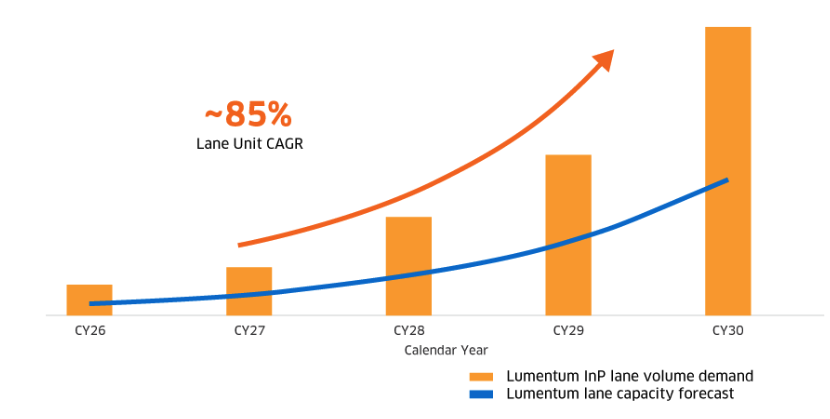
Lumentum CEO Michael Hurlston has described the supply challenge as potentially more significant than the memory-chip shortage that has attracted attention from markets. Lumentum expects the volume of indium phosphide lasers going into AI data centers to grow at roughly 85% annually. He framed the problem as a change in scale, noting that telecoms firms used to order lasers in the hundreds while Nvidia and the cloud providers now order them in the hundreds of millions.
Figure 1: InP Demand Continue to Outgrow Supply
Why More Capital is Not a Quick Fix?
The first obstacle is geological. Indium is not mined as a primary commodity but rather recovered in small quantities as a by-product of zinc processing. That means laser demand cannot, by itself, bring a large new supply of indium to market. Increasing output would require more zinc to be mined and processed, and those decisions are driven primarily by the economics of the zinc market rather than demand from AI.
The second constraint is industrial concentration. By one estimate, three companies (Sumitomo Electric and JX Advanced Metals of Japan and AXT of the United States) supply roughly 75% of the world's indium phosphide wafers. The third obstacle is manufacturing difficulty, because growing these crystals to the required purity is slow and unreliable, and only 15% to 50% of each wafer yields usable lasers depending on the generation. The specialist furnaces that grow the crystal carry waiting lists of 18 to 24 months, so a company deciding today to expand will wait roughly two years for its equipment.
Demand meanwhile continues to grow fast. The newest and fastest modules use eight lasers where the previous generation used four, and TrendForce expects global shipments of these modules to reach 92 million units in 2026, up from 26.5 million in 2023. LightCounting's April 2026 forecast put shipment growth at 93% in 2024 and an estimated 82% in 2025, with a further 65% expected this year. The rate is slowing, but it is slowing from an extraordinary base, and the firm reports demand still running 30% to 50% ahead of what suppliers can deliver. Waiting times on the fastest modules now exceed 40 weeks.
The supply chain also has a geopolitical dimension. China has restricted indium exports since February 2025, and the price moved from roughly $250 per kilogram to about $805 per kilogram by August 2026. A standard wafer that cost around $1,400 before the restrictions now costs closer to $5,000. Beijing released a batch of export permits in May 2026, though order backlog data from AXT suggests the relief went to selected buyers rather than to the market as a whole.
This helps explain Nvidia's strategy. Nvidia invested $2 billion each in Coherent and Lumentum in March 2026, alongside purchase commitments and guaranteed access to future output. This was widely seen as a bet on optical technology. Nvidia also took a direct position in Scintil Photonics in September 2025 and joined Xscape Photonics in March 2026, both of which build lasers that produce more data per unit of material. Nvidia is funding the incumbents to make more crystal and funding startups to need less of it.
Startups are betting they can design around the shortage rather than wait for it to clear. California-based AvicenaTech, Corp. is one such start-up. The company replaces lasers with arrays of very small light emitting diodes for short connections inside a single rack, which sidesteps indium phosphide completely for that class of link. Backed by SK hynix, Samsung, Micron Ventures, the company has raised roughly $120 million in total.
France-based SCINTIL Photonics builds the lasers directly onto a silicon chip, so a single chip does the work of dozens of separate parts and uses roughly one sixth the power of a conventional module. The company raised a $58 million Series B in September 2025 led by Yotta Capital Partners and NGP Capital. The company, backed by Nvidia, has already started production.
Based in California, Quintessent is another key start-up in this field. It raised a $40 million Series A round in August 2026, bringing its total to about $52 million. Its lasers also sit on ordinary silicon, and each one produces eight separate beams of light where rival designs need eight lasers to do the same job. That makes it the most direct answer to the shortage of any company here.
What’s a Rich Text element?
Heading 3
Heading 4
Heading 5
The rich text element allows you to create and format headings, paragraphs, blockquotes, images, and video all in one place instead of having to add and format them individually. Just double-click and easily create content.
Static and dynamic content editing
A rich text element can be used with static or dynamic content. For static content, just drop it into any page and begin editing. For dynamic content, add a rich text field to any collection and then connect a rich text element to that field in the settings panel. Voila!
How to customize formatting for each rich text
Headings, paragraphs, blockquotes, figures, images, and figure captions can all be styled after a class is added to the rich text element using the "When inside of" nested selector system.
Ready to partner with MVP?
