Navigating the AI Supercycle: Where Will the Value Accrue?

This is a follow-up to our first house view, Are We in an AI Bubble?, which made the case that demand and capacity will justify the AI infrastructure buildout. Here, we turn to the next question: where does the value actually accrue?
Has open source capability caught up to the frontier?
The easy answer is the frontier labs, today primarily Anthropic, OpenAI, and Google, with Meta and SpaceX behind them. Look back at the inputs to capability: they reduce to algorithmic advances and compute, which reduce to talent and capital. The two feed each other. Capital buys compute. Compute access, plus the chance to do pioneering science alongside the best researchers alive, attracts talent (the money helps). Talent produces breakthroughs that raise more capital. That flywheel is why the frontier has stayed concentrated in a handful of labs.
So why do headlines keep saying open source[7] has caught up to the frontier? This story is overblown for two reasons.
First, the parity story rests on benchmarks that flatter open models. Epoch finds open-weight models perform worse on private benchmarks than public ones, plausibly because they optimize harder for the public ones, and decontaminated test sets show larger gaps than official scores. Line up the three kinds of measurement and the picture is consistent: public static benchmarks say near-parity; Epoch's broader capability index says a stable one-generation lag, with the frontier's lead expanding from three months in October 2025 to four in April 2026; and the Center for AI Standards and Innovation (CAISI), testing on private, agentic, real-world tasks, finds large gaps in software engineering and cyber.
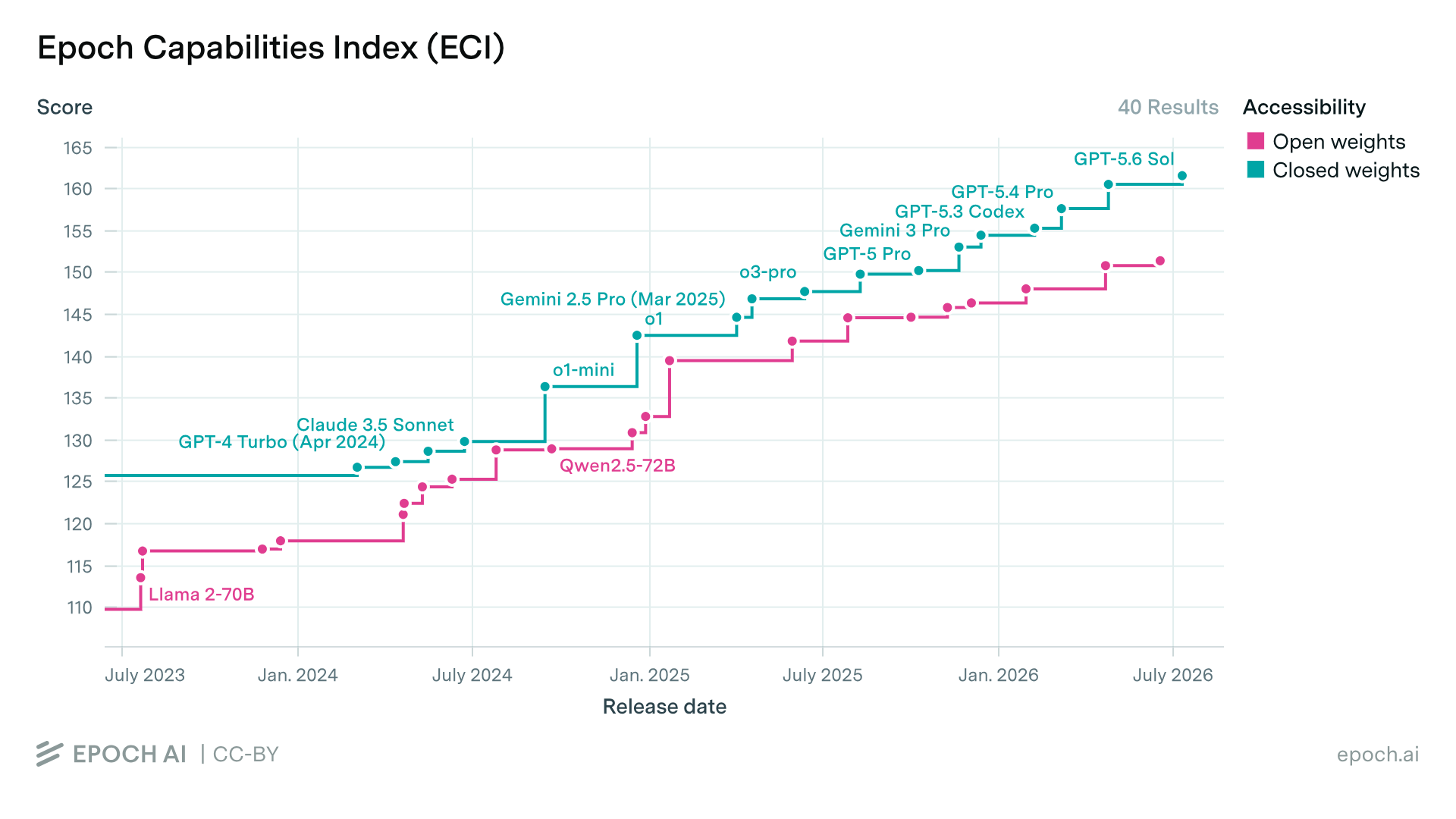
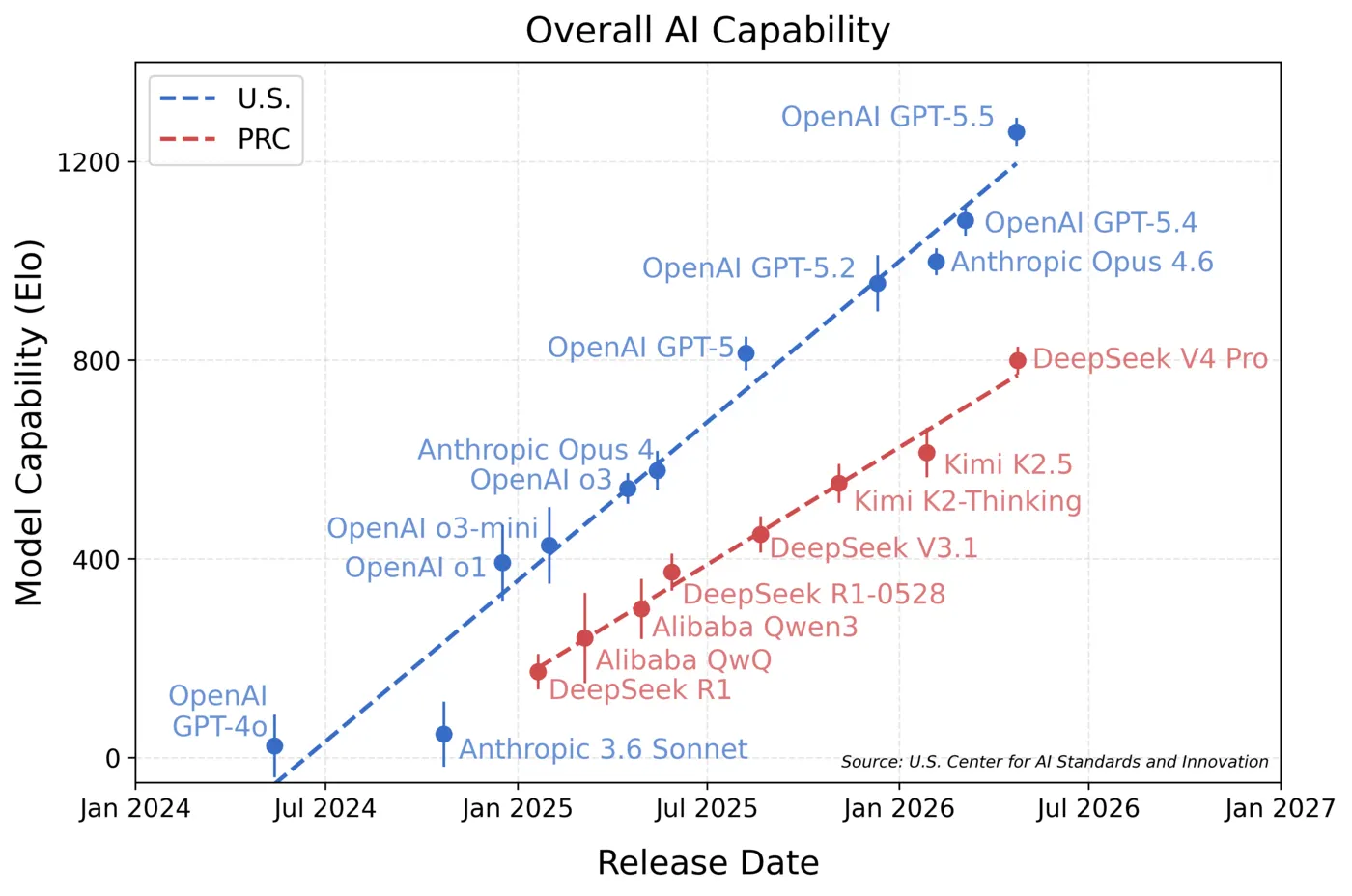
Second, the gap is jagged, and the jaggedness is where the confusion lives. Line up open vs. closed by how hard the task is and the gap grows as the work gets harder.
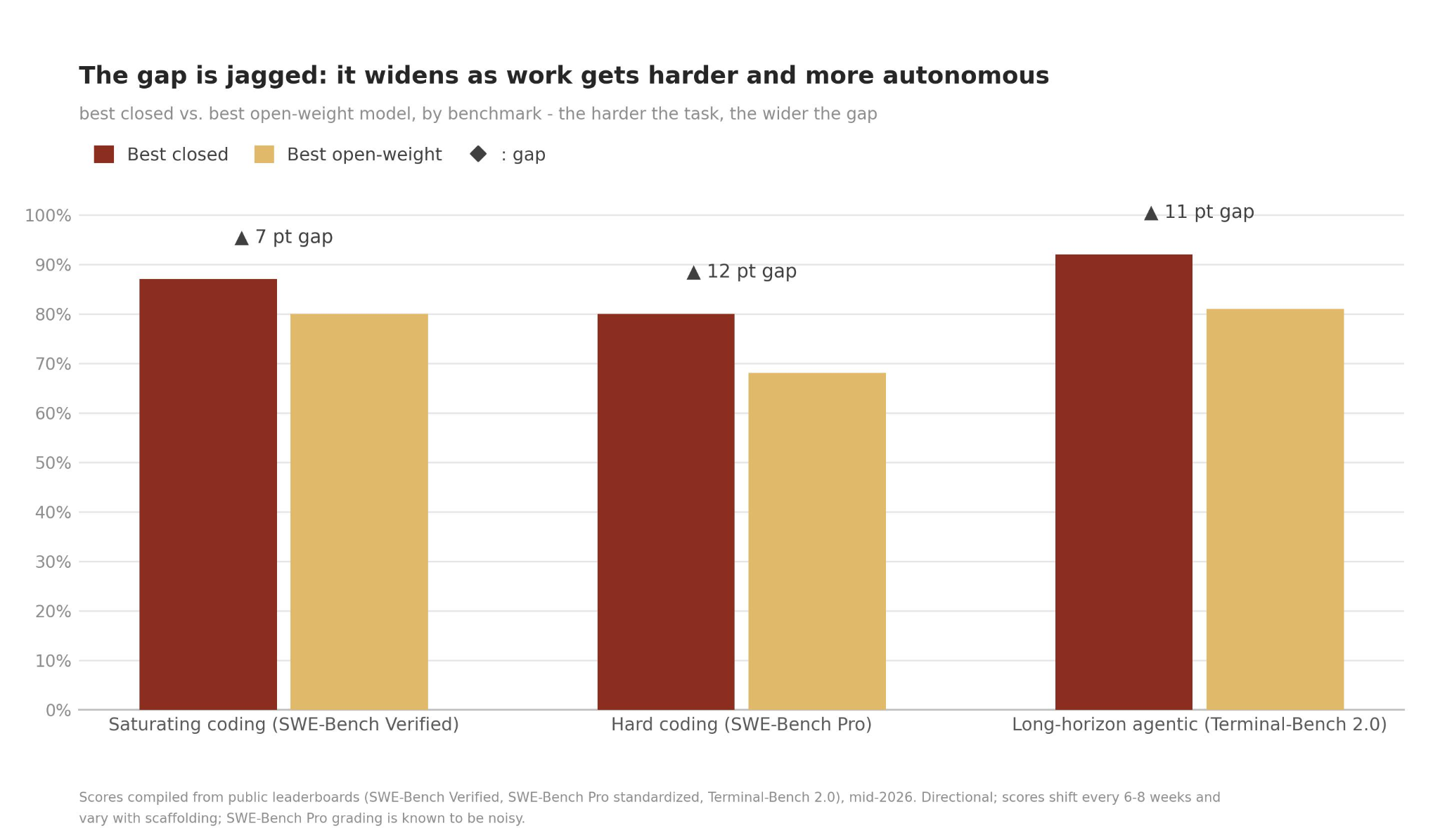
On easy, single-turn coding, open source has essentially caught up. On SWE-Bench Verified, the best open-weight models (DeepSeek V4, GLM-5.2, Qwen 3.7, Kimi K2.6) all sit right at the ~80% mark, trailing closed leaders by only a few points. But because the benchmark is effectively saturated, that parity offers diminishing signal.
On harder coding, the gap reopens. On SWE-Bench Pro, run through identical scaffolding so the model is what's being tested, the best open weight sits in the high 60s against closed leaders near 80. Same skill, harder problems, and the distance returns.
There’s a similar gap on long-horizon agentic work. Terminal-Bench 2.0 tests end-to-end autonomous tasks: compiling code, standing up servers, sysadmin work over many steps. The closed frontier leads by low double digits, and the best open model ranks well down the board. This is the terrain the frontier just moved onto, and it's the least contaminated measure of the real gap.
Moreover, where open source is making up the most ground is with larger, more expensive models that look more like the frontier than their open source counterparts. Kimi K3, the open source leader nearly across the board, is 2.8T parameters and costs $0.84 per task (Artifical Analysis), roughly at par with comparable models from OpenAI and SpaceX and ~25% above the next leading open source competitor.
The real state of play: open models are not accelerating toward the frontier, and the several-month gap holds steady. The flywheel is real and the moat is real, but the moat is denominated in time, as everything a lab discovers diffuses on a lag. The mechanism is distillation: generate millions of high-quality outputs from the best model, train a cheaper model on them, and you have pulled most of the model gap through the front door.
What cannot be pulled through an API is the machinery around the model: the RL environments it trained in, the evals that graded it, the memory and context infrastructure, and the telemetry from real deployments. Telemetry is the one that needs unpacking, because it is two different assets and the labs only hold one of them.
Who pushes the capability frontier going forward?
The market is now moving onto exactly the terrain where the leak stops working. As tasks get longer and more agentic, the gap should widen. Two reasons.
- The math. Long tasks compound per-step reliability. A model that succeeds 99% of the time per step finishes a 200-step task about 13% of the time. At 99.5%, about 37%. Reliability edges that are invisible on single-turn benchmarks become fundamental at long horizons.
- The training. Long-horizon reliability comes from RL over full agentic trajectories in rich environments: compute-heavy, environment-heavy, and fed by deployment telemetry. The labs keep the raw capital advantage, since they can always buy more practice with more compute. Telemetry is more complicated, and it splits in two:
- Trajectory telemetry is what was asked and what came back. A closed lab sees 100% of this, because every token flows through its own API. An open lab sees only its first-party slice, since most of its adoption runs on Together, Fireworks, OpenRouter, or self-hosted clusters, precisely because the weights are free to take elsewhere. The mechanism that wins open source its token share is the same mechanism that leaks its improvement flywheel.
- Outcome telemetry is whether the work was right. Did the ticket resolve, did the note get signed, did the claim pay, did the lease close. RL needs a grade, and this is the grade. It does not live in the API. It lives in the customer’s system of record, and the company holding it is the application company sitting one layer above the model. So on the signal that matters most for the next tier of capability, the labs own the trajectory and rent the outcome. The labs are answering this by owning the surface. Coding is the proof as the one workload where a lab built all the way to the product, and it is the workload where the capability lead is largest and holding. Vertical integration stops being a revenue decision and becomes a training decision, and where they cannot integrate, they buy the equivalent: forward-deployed teams inside enterprises and manufactured environments that simulate the workflow. What the application company does with the asset it holds is a question for the next section.
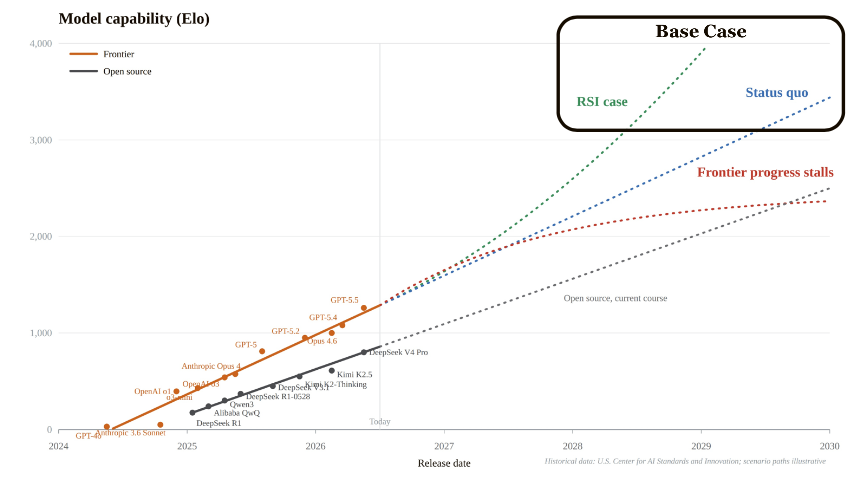
The biggest technical moat is still ahead: recursive self-improvement (RSI), models accelerating the construction of the next model. Models are already doing the tedious engineering (compilers, kernels, optimization) that speeds up the next training run. MIT and Stanford groups have demonstrated models that iterate on and train themselves in real time. Jack Clark, Anthropic's co-founder, estimates a ~60% chance of automated, no-human-in-the-loop RSI by the end of 2028, and ~30% by the end of 2027. If AI discoveries build on each other in an exponentially compounding loop, then the gap stops being a lag and starts widening indefinitely.
So can open source catch up? If intelligence follows the S-curve of every prior technology–slow start, steep ramp, plateau–frontier capability commoditizes (with a different curve for each workload, as this section covers shortly). However, if a lab reaches recursive self-improvement first, the gap compounds indefinitely. For what it is worth, the frozen-target world is hard to square with Part I: if work keeps falling tier by tier on the timeline laid out there, and if progress keeps coming from the labs that built the capital-and-talent flywheel, a stalled frontier is a low-probability path.
If open source can't win on capability, what can it win on?
The crux of frontier vs. open source is cost more than capability. The current debate reignited when token-budget blowouts (“tokenmaxxing”) at Meta and Uber triggered enterprise-wide AI budget reviews, and attention turned to open models offering inference 7-8x cheaper at ~90% of the capability (MIT Sloan and HBS). The usage data seemed to confirm the shift: cheap Chinese open models absorbing a rapidly growing share of total token volume.
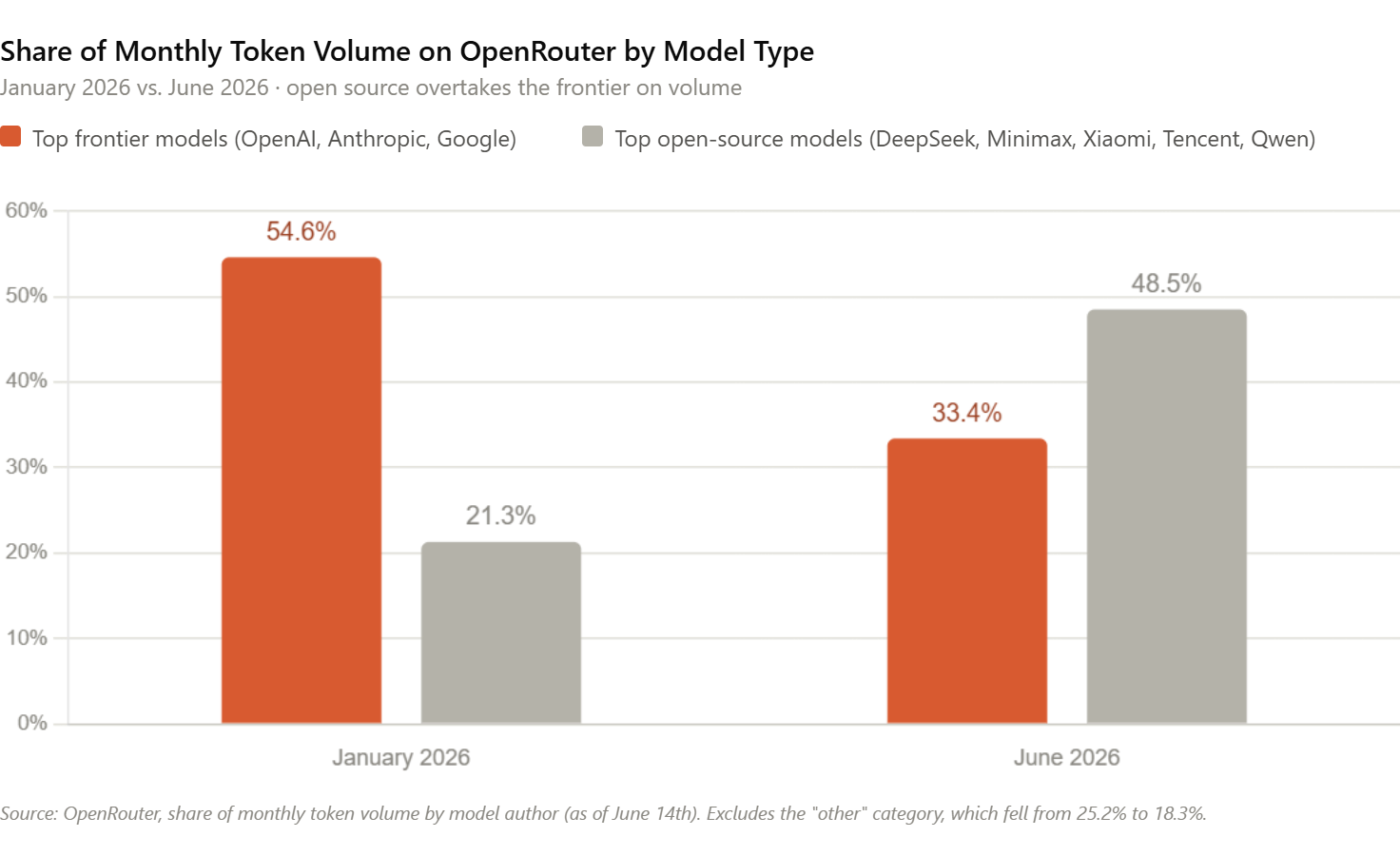
The debate has since matured into a broader thesis, fueled by Palantir CEO Alex Karp going on CNBC and hitting the panic button on behalf of every AI product company sharing its IP with a lab, by the Anthropic Fable 5 controversy with customers and policymakers, and by the EU passing the Cloud and AI Development Act (CADA) in June. The argument goes as follows:
- Cost. Open source inference is far cheaper at near-parity capability for many tasks.
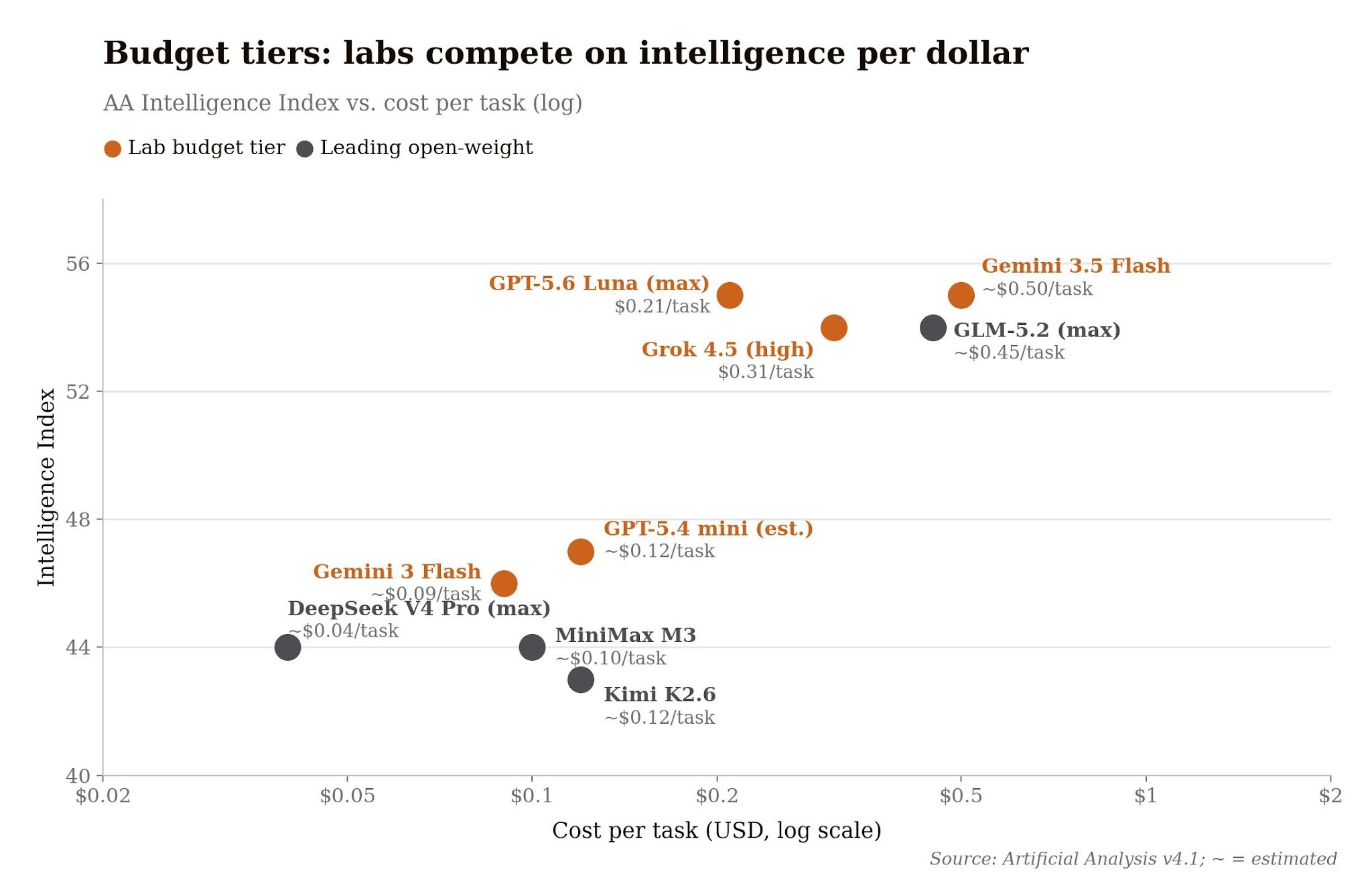
- Control. Renting the same generic intelligence as your competitors erases your edge, while pouring proprietary expertise into systems you control builds a moat.
- Data sovereignty. Frontier labs will increasingly retain data for regulatory and national security reasons. The US CLOUD Act lets Washington compel any domestic provider to hand over data wherever it sits—a major sticking point for international regulated enterprises and sovereigns. CADA sets binding EU-wide rules to cut Europe’s strategic dependence on non-EU technology providers. Its four-tier sovereignty framework puts public sector, defense, and critical infrastructure workloads entirely beyond the legal reach or operational control of foreign governments.
- Reliability. Models running on your own hardware or dedicated inference platforms cannot be deprecated, rate-limited, or pulled out from under you by a lab or a government, a risk that stopped being theoretical in June when a US export control order forced Anthropic to pull its two newest models for every customer worldwide for 18 days.
- IP. AI product companies also increasingly express concern that labs use market knowledge gleaned from customers to launch competing products.
However, if you stress-test the five planks, most of them wobble. Ranked from the easiest gaps for labs to close to the most structurally challenging:
- Cost: the labs can compete. Each offers a family of models from frontier to small, with the latter priced competitively against open source. Moreover, labs can subsidize the commodity tier with frontier revenue. Grok 4.5's competitive pricing shows closed labs will fight for the commodity tier on price rather than cede it.
- Control: the labs can compete. What labs cannot offer is anything that changes model weights: continued pretraining on proprietary data, or distillation into small models deployed at the edge. In practice, though few enterprises actually want to change weights. They generally lack the resources, and a customized model must be re-customized every time the base model generation turns over, while rented frontier models update automatically. Most enterprises land in the same place: put proprietary data in the context and retrieval layer around the model, and rent the strongest available intelligence underneath it—where labs actually have an advantage. You can see it in the numbers: 76% of enterprises now buy their AI products rather than build them, up from 53% a year ago, and only 3% are fine-tuning open weights.
- Data sovereignty: solvable for US enterprises, structural for foreign sovereigns. Technically the labs can do almost everything: zero-retention contracts, confidential computing, regional deployment, national-cloud partnerships. No US statute today compels frontier labs to retain user data, though every serious misuse incident builds pressure for mandatory logging and identification. For US companies, compelled retention is tolerable; the compelling authority is their own government, and there is accepted precedent in banking and telecom. The CLOUD Act problem is jurisdictional, so especially for EU public-sector, defense, and critical-infrastructure workloads under CADA, no architecture fixes it. That segment is structurally ceded to open weights.
- Reliability: a structural open-source win. Labs can mitigate with dedicated capacity, on-prem deployments, or sovereign-cloud arrangements, but every option keeps a licensing and operational tether to the lab and its government. The only true fix is shipping weights, which US labs will not do for their best models, for competitive reasons and for nonproliferation reasons.
- IP: existential for AI product companies. On the platform-competition fear, the precedents are instructive. Amazon ran private-label products off marketplace data for years. Microsoft has bundled and crushed categories since the 1990s. Apple competes with its own App Store developers. Platform risk does not kill platforms when the platform is indispensable, and frontier intelligence will be indispensable for high-value use cases (Cursor stayed on Anthropic for coding even after Claude Code launched). Labs will not bother competing in categories too small to matter on revenue alone, and the remaining quadrant, large markets full of low-value work like customer service, is where open source wins anyway. This weakens the IP argument: any customer for whom open source clears the capability bar will have migrated on cost alone, long before IP protection enters the calculus. With that said, a lab's interest in a workflow is no longer only the revenue. Training data, as much as revenue potential, will dictate which verticals the labs integrate into, and a lab will accept a worse business to get a better training set, subsidizing the loss with frontier revenue for as long as it wants. An application company handing its workflow telemetry to a lab is arming the competitor most likely to enter its market.
Notice that the stress test does not produce one verdict. It sorts the customers. Foreign sovereigns and the workloads regulation fences off appear to be structurally ceded. For enterprises, only data sovereignty and reliability hold up under scrutiny while open source implementation challenges generally outweigh the benefits except for the largest, most tech-forward organizations. For AI product companies, IP protection is survival, and it is the real load-bearing argument for adopting open source. So the question “will open source win?” is badly posed. The right question is which customers the labs keep and which they lose. The rest of this section takes the two contested segments in turn, then the one variable that governs both.
Enterprise-frontier lab engagement is stickier than headlines suggest
The “Tokenmaxxing” headline appears to be the product of cherry-picked examples rather than a broader trend: SemiAnalysis's survey across 50+ enterprises attributes the token blowouts to poor incentives and lax oversight rather than open-vs.-closed economics, and Accel's developer survey found CFOs were 7x more likely to tell developers to spend more on tokens than less.
Meanwhile, the enterprise mix-shift to open source models fails to show up in the data: open source's share of enterprise LLM spend is actually falling: 11%, down from 19% a year ago (Menlo Ventures). Even where open source should win outright, foreign sovereign deployments, the frontier is winning today: Anthropic's EMEA revenue grew 9x year over year, with large deployments in regulated industries like Goldman Sachs in finance and Optum in healthcare. Sovereigns and large enterprises are explicitly prioritizing capability above all else; at least for now.
It is a classic stated-vs.-revealed-preference conundrum. Everyone loves the idea of ownership and model sovereignty, but the data says enterprises keep writing bigger checks to the frontier labs every quarter. Open source is winning the popularity contest but closed models are winning the business.
And while revealed preference could still flip as open models improve, two barriers may make that flip slower than open source proponents expect:
- Capable open source is fleeting. The best open models exist at the pleasure of whoever trained them, and owners keep reaching the same conclusion: frontier-grade models are too powerful and too expensive to give away. Meta closed its models for three reasons: an astronomical capex bill incompatible with giving the output away, a conclusion that adversarial distillation of its weights was subsidizing rivals, and a proprietary human-data pipeline (the Scale deal) whose value only survives behind closed weights. China is moving to enforce closure on its own frontier models, which would take the best open models off the table for anyone building in the West. The pattern is consistent: companies open when they are behind and close when they think they can lead. OpenAI did it after GPT-2. Meta just did it. China is enforcing it. Nvidia is underwriting Western open weights as demand insurance (its Reflection AI backing, its own Nemotron line), but anyone building high-quality products on open weights risks being stranded on the second tier.
- Enterprises adopt ecosystems, and ecosystems lock in. Adoption skews frontier from the start, for the reasons above: calling an API is frictionless, and few enterprises have the talent to customize and route across a suite of open models. The agentic shift turns that easy adoption into a hard exit. Agents accumulate what the model did not come with: conversation history, context built on company data, and integrations tuned to the quirks of one lab’s API. Pulling the model out means rebuilding all of it, and every quarter of use deepens the debt. The numbers bear this out: only 6% of enterprise leaders say they could stop using their primary AI vendor tomorrow without interruption, and of those who actually attempted a migration, 66% found it failed or took far more time, labor, and money than expected. There is a way out: Store that history, context, and behavior in a harness you own rather than inside the lab’s stack, and the model underneath becomes swappable. Only large, tech-forward enterprises and AI product companies have the engineering talent to build one, and even they hit a wall: most agentic tasks still need frontier intelligence for at least one step, so orchestrating a chain across models means keeping the frontier in it anyway. They will try, because the prize is model optionality. Most of the economy will not, and will stay where it started.
Add it up and the labs likely keep the enterprise segment longer than people think. Where they lose enterprise workloads outright, they lose them to regulation, the sovereign carve-out above. The other leak is subtler: enterprises increasingly buy finished AI products instead of raw model access, and the model choice inside those products belongs to the vendor.
AI product companies are where open source actually wins (over time)
With that said, the shift of token consumption toward open models remains undeniable. How do we reconcile that with the spend data? Start with who is actually burning the open tokens. It is mostly not enterprises running weights themselves; the buy-vs.-build and fine-tuning numbers above rule that out. It is AI product companies, serving commodity workloads at enormous volume on models they control, and selling the finished product to the same enterprises that keep writing bigger checks to the labs. The enterprise dollars flow to the frontier. The open tokens increasingly flow through the applications. For the applications, the decision to adopt open source vs. frontier models is timing rather than unwillingness, and the timing runs on the maturity of the use case.
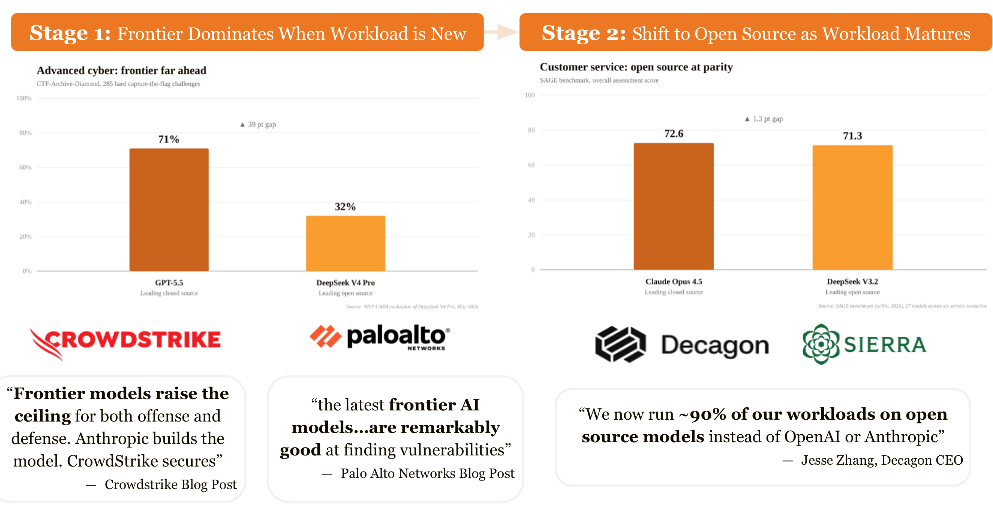
- Stage 1: When a use case is new, you want the smartest general-purpose model available. You do not yet know the shape of the problem, so you pay a premium for intelligence you may not need. You are primarily proving the technology works at all, and cost optimization is secondary.
- Stage 2: Once a use case is fully built, when you know the input distribution, the behaviors, and the failure modes, the trade flips. Optimization shifts from maximizing intelligence to maximizing intelligence per dollar. At that point cost and IP protection tip the scales toward open source, with reliability, sovereignty, latency, and control stacking behind them.
- The read-through: Last year enterprise AI budgets scaled, and thousands of brand-new use cases spun up at once, most of them built by the labs and the application companies serving those budgets. New use cases run on frontier models, so closed share exploded. The contraction in open source’s spend share from 19% to 11% is a denominator problem: the pool of immature use cases is growing faster than the pool of mature ones.
You can see the lifecycle inside today's top AI application companies. Decagon runs ~90% of its customer-service workloads on smaller open models, because a resolved ticket is a resolved ticket and extra intelligence adds nothing. Healthcare scribes like Abridge doing commoditized notetaking and summarization run mostly open, a decision made easier due to strict data policies for liability reasons. Coding companies like Cursor (before the SpaceX acquisition) and Cognition split the difference: a cheap open workhorse absorbs commodity volume like autocomplete and code edits, and the frontier gets the long, complex agentic tasks. Frontier labs keep the highest-complexity tokens while volume migrates to post-trained open models.
The crux: how long does the capability gap hold?
Sun Microsystems, which sold expensive integrated servers and the software that ran them, commanded a $200B+ market cap at its peak while its platform was genuinely better. As commodity Linux, the free operating system anyone could run on cheap hardware, matured to good enough workload by workload, the premium collapsed in parallel: Sun was ultimately acquired by Oracle for just $7.4B, a 96% destruction of value from its peak.
That precedent is the best version of the open-source case, and it holds or fails on one question: does the target freeze? The important refinement is that freezing is local. Linux did not wait for computing to stop advancing. It took file serving, then web serving, then databases, one workload at a time, while the high end kept moving away from it. The same thing is happening here. Customer service resolution has frozen. Clinical note generation has frozen. Code autocomplete has frozen. None of that required the frontier to stall, only that those specific jobs reached the point where more intelligence adds nothing a buyer will pay for.
So this is a question about two rates. How fast does the frontier open new tiers of work, and how fast do old tiers freeze behind it? Recursive self-improvement is the one development that settles it outright, because it lets the frontier open tiers faster than any fixed rate of freezing can close them. Absent that, the two rates are close enough that the answer differs by customer.
So who wins, frontier or open source? The answer is: both
"Who wins" is two questions, and only one of them is close
The first question is whether enterprises leave the labs directly for open weights. The sections above answer it: mostly no. Open source's share of enterprise spend is going down, adoption skews frontier from the start, and the agentic shift turns easy adoption into a hard exit. Sovereignty and reliability carve out a real segment, but a niche one at that. This question is largely settled, and it is the less interesting one.
The second question is whether the frontier lab or the application company ends up owning the workflow. This one is genuinely open, and it is where open source actually matters. Open source is the supply of ammunition rather than a party to the fight. An application company running on a lab's API is paying frontier prices on commodity work and handing the lab a record of its own workflow at the same time. The only way out is onto models it controls, and that route exists only where open weights have caught the frontier on the specific job that company does.
The lab win condition: hold the frontier long enough. Every lever here is one capital can buy. Trajectory telemetry from the API, which does double duty as market research by showing which use cases actually drive volume and which categories of agents people are building. Synthetic data and manufactured environments to extend that telemetry into workflows they cannot observe. Algorithmic efficiency gains, whatever pre-training has left, and better harnesses on top. The capital and talent flywheel produces all of it, and recursive self-improvement is the extreme version where the lead stops being a lead and becomes a gap. There is also a floor under this case: some verticals will always buy the best available intelligence regardless of price, because the cost of being wrong is catastrophic. Cyber is the clearest example, and the labs are already selling frontier capability straight into it.
The application win condition: get off the frontier without losing the customer. This requires two things at once, and one without the other is worth nothing:
- Supply side. Open models plus the software infrastructure the applications have built (post-training, harnesses, orchestration across smaller models) have to reach parity on the specific workloads that company serves
- Demand side. The company has to have reached product-market fit at scale with real enterprise buyers on high-volume commodity work, so that the volume flowing through it is large enough for the telemetry to compound into something. More importantly, this also means its market position is defensible from labs that may be considering entering their vertical.
This defensibility is best understood through two key moats:
- Outcome loops. Every resolved ticket, signed lease, or paid claim is a labeled training example that arrives free. Volume buys three things a new entrant cannot rebuild: a map of where the system breaks for this specific customer, calibrated escalation thresholds that show up as a ten to fifteen point resolution gap in production while staying invisible in a demo, and a commercial weapon, because the same data proves ROI at renewal and turns the price conversation into a value conversation. Selling a completed result rather than assistance toward one magnifies the lock-in here: this is what makes the training data more valuable and makes the vendor harder to unbundle.
- Workflow integration depth. Wiring into the CRM, the ticketing system, and the system of record, so that removal means re-plumbing dozens of integrations and retraining an operations team. The stronger version is the thousands of hours a customer spends encoding its own policies, escalation rules, tone, and edge cases into the system. The strongest version is when managers start running their teams off the vendor's dashboards, at which point the vendor has moved from a tool to infrastructure.
Note that these moats cut both ways: the labs are building these downward from the model, while the application companies are building them upward from the workflow. Whoever gets there first holds the customer when the workload underneath goes commodity.
Both cases are credible, and both are investable
Which way it breaks is a question of rates. The frontier opens new tiers of work. Old tiers freeze behind it. Whichever runs faster takes the share. The asymmetry that favors the applications is that freezing is cumulative and permanent, while the frontier's lead has to be re-won every generation. What favors the labs is that they do not need to win permanently. They only need to keep opening tiers faster than old ones freeze, and convert each window into the moats above before anyone else gets there. If the labs stay ahead of the freeze, call it ~20% of tokens at a 10x premium, which works out to ~70% of industry revenue. If the freeze outruns them, ~5% of tokens at 5x, or ~20% of revenue. The error bars on both are wide.
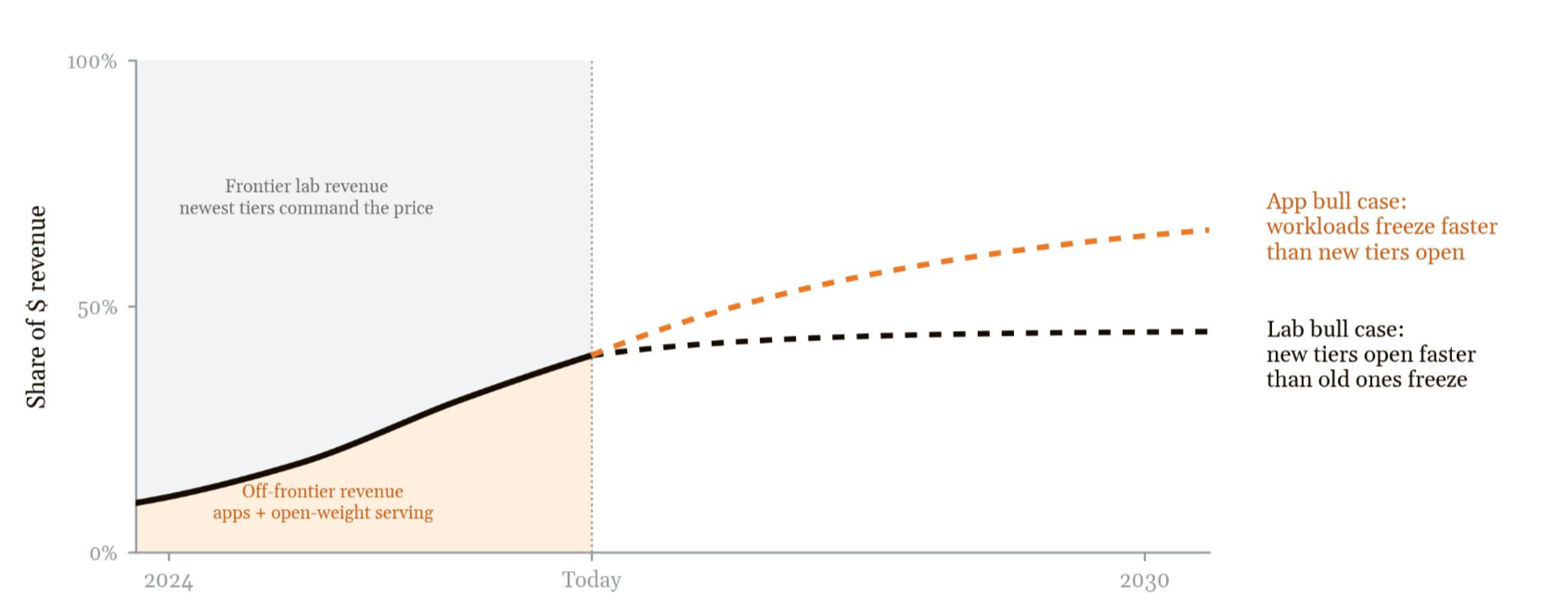
Regardless of the specific assumptions, it is a positive-sum split rather than a fight over a fixed pool. The market being divided expands from roughly $175B today toward several trillions by 2030. A compressed premium on a market 25x+ larger still grows lab revenue by an order of magnitude in four years. A commodity price on exploding volume grows the monetizable surface underneath the applications faster still. There is enormous value on both sides of the line, so our job here is a weighting exercise across two positions that both deserve capital.
Part II Conclusion
In technology, the infrastructure layer builds the value but doesn’t keep it. The value flows to the application layer, and history shows the application layer grows into many times the size of the infrastructure that carried it.
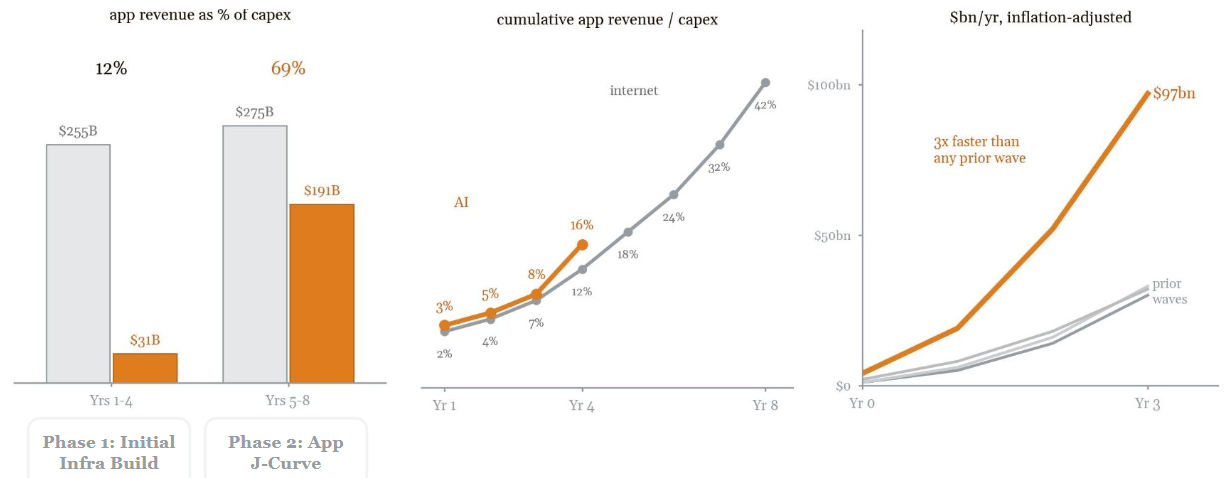
The internet buildout, for example, ran in two phases. In the first four years the money went into infrastructure: fiber, routers, servers, data centers. Over the following four years capex barely moved, while application revenue grew six-fold. The infrastructure was the precondition; the applications were the payoff. AI is running the same curve, and we’re actually ahead of the internet's pace at the same point: AI application revenue reached $97B in year three, roughly three times what any prior technology wave produced at the same age on an inflation-adjusted basis.
The initial infrastructure has been built and, more importantly from our investor seat, this is where the returns in the first four years of the AI trade were made: Nvidia, the hyperscalers, the utilities, the equipment suppliers. These returns were made primarily in the public markets; anyone could own that trade.
I read this data, in conjunction with the paradigm shift in capability advancement from pre-training to reinforcement learning, as the handoff from phase one to phase two. The application layer is where the next big winners will show up, and in contrast with the phase one winners, these companies will largely be private. Some of those winners will end up buried inside larger public companies, the incumbent SaaS names and the hyperscalers. But most of this value is being created in the private markets right now, by the frontier labs and the application companies. This is our opportunity to lay claim to the next and more valuable leg of returns, in what is already proving to be one of the most consequential technology cycles in history.
There are two key reasons why developing a view is essential. The first is the opportunity. The adoption cycle is young enough that identifying winners now means owning them through the entire compounding period rather than the last leg of it. The second is the cost of being wrong, which in this sector is unusually high. Part I made the point: for every Amazon or Google, there were many other companies shaped like eToys and Webvan. We expect this sector to produce some of the largest power-law outcomes in history, and a distribution that wide at the top is equally wide at the bottom. Being active at this layer is necessary. Being right is what determines the return–and that is what Part III will tackle: honing our scope.
Looking for More?
While Part II outlines the macro framework for where value will accrue across the AI stack, capturing this opportunity requires evaluating specific companies against these dynamics. We maintain a detailed view on target categories and private market names positioned to navigate this shift.
If you are interested in discussing our target list and actionable thesis, please reach out to your MVP representative or contact us directly at mvp@mvp.vc.
Notes and Disclaimers
[4] Component inflation is an accelerant: Cost per GW has doubled to tripled since the start of the year, per Gavin Baker. Microsoft pinned about $25B of its raised 2026 capex guidance on component prices alone, and Meta about $10B.
[5] One refinement: a growing share of builds are lower-cost custom-silicon campuses at $30-35B per GW, which need only $13-15B per GW per year. At a realistic mix the bars below run 10-15% lower
[6] Situational Awareness is reported to have unwound its entire public equities book on July 30, 2026, selling to Citadel following losses on AI infrastructure longs and software shorts ("Citadel Buys Situational Awareness's Stock Portfolio After Big Losses in AI", Wall Street Journal). I have kept the references to his work. What failed was the expression of the trade rather than the long-run capability thesis cited here.
[7] Open-source models publish their underlying parameters for anyone to download and run; frontier labs keep theirs private and sell access.
[8] Conflicts of interest and valuation. MVP, its affiliates, the funds and vehicles it advises and their personnel hold interests in multiple companies discussed in this material. VNTR Securities, LLC does not act as placement agent for any company discussed. MVP Manager, LLC, an affiliate, advises special purpose vehicles that may hold, and may offer or sell, interests in companies discussed here, and MVP and its affiliates receive compensation in connection with those vehicles. As a result, MVP and its affiliates may be offering or selling interests in a company at the same time this material is distributed, and may buy or sell at any time, including in a manner inconsistent with the views expressed here and including before publication. Readers should assume MVP has a financial interest in the companies discussed and that its interests may differ from theirs, and should read this material with that conflict in mind. The companies discussed are privately held; interests in them are speculative and illiquid and involve a substantial risk of loss, including total loss of capital, and there is no public market for them. Valuations referenced reflect prices reported in the most recent financing round known to MVP as of the date indicated; they are not independent valuations, may be stale, may reflect terms not applicable to other share classes, and may differ materially from realizable value. Statements of relative value are MVP’s opinion and are not price targets. Nothing in this material is a recommendation to buy or sell any security.
What’s a Rich Text element?
Heading 3
Heading 4
Heading 5
The rich text element allows you to create and format headings, paragraphs, blockquotes, images, and video all in one place instead of having to add and format them individually. Just double-click and easily create content.
Static and dynamic content editing
A rich text element can be used with static or dynamic content. For static content, just drop it into any page and begin editing. For dynamic content, add a rich text field to any collection and then connect a rich text element to that field in the settings panel. Voila!
How to customize formatting for each rich text
Headings, paragraphs, blockquotes, figures, images, and figure captions can all be styled after a class is added to the rich text element using the "When inside of" nested selector system.
Ready to partner with MVP?
